
C95500 Aluminum Bronze Bracket Investment Casting
Custom C95500 aluminum bronze bracket produced by lost-wax investment casting for pump and motor mounts, actuator supports and marine auxiliary equipment, with finish machining for bores, threaded ports and mounting faces.
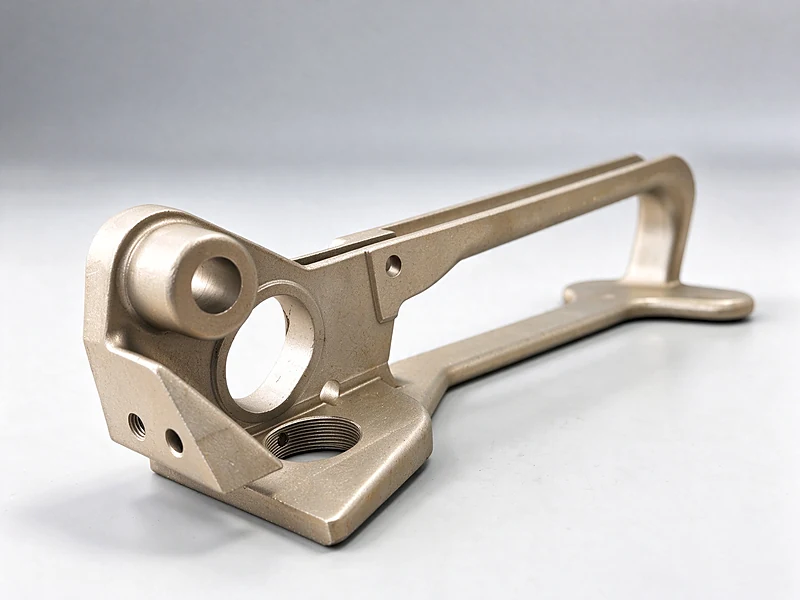
C95500 Aluminum Bronze Bracket
This custom bracket is cast in C95500 aluminum bronze through precision investment casting, also called lost-wax casting. The single casting combines a boss with two bores, a large through bore, a threaded port, a ribbed arm and a foot plate, so the support structure is produced as one piece instead of a welded assembly. Bores, boss faces, threaded port and mounting pads can be finish-machined to customer drawings.
Product Specifications
| Material Grades | C95500 aluminum bronze; C95400, C95800, C93200, C93700 and other copper alloy grades on request |
|---|---|
| Product Category | Bracket / Support Structure / Bronze Machined Component Castings |
| Casting Process | Investment Casting (Lost-Wax / Silica Sol Shell Bronze Casting) |
| Machining Support | Machining support: turning, milling, boring, drilling, tapping, face milling of mounting pads, bore and threaded port machining; operations arranged to approved drawings |
| Surface Finish | As-cast, shot blasted, machined bronze finish, brushed or polished finish; protective oil or passivation treatment as required |
| Tolerance | Casting tolerance typically ±0.2mm; machined bores, threaded ports and mounting faces controlled to drawing tolerance |
| Certification | ISO 9001; chemistry, dimensional inspection and selected inspection records can be arranged when required |
| Order Quantity | Reviewed after drawing and quantity confirmation |
| Lead Time | Confirmed after drawing review and scheduling; sample timing evaluated separately |
| Customization | Custom bracket outline, boss and bore dimensions, threaded port size, arm section, foot plate drilling, wall thickness and finish according to drawings or samples |
Need a Custom C95500 Bronze Bracket?
Send us your drawings, samples or service conditions for a quotation after drawing or requirement review.
Get a Free Quote WhatsApp UsProduct Overview
The C95500 aluminum bronze bracket is a custom investment casting supplied by Wuxi Huayong Metal Technology Co., Ltd. Using the lost-wax silica-sol shell process, Huayong produces the bracket close to final shape: the boss, through bore, threaded port, ribbed arm and foot plate are formed in one casting, which removes the welding and assembly steps a fabricated bracket would need.
Each bracket can be reviewed before tooling for wall thickness, gate location, shrinkage risk, machining allowance and bore alignment. After casting, machining can finish the boss faces, bore, threaded port and mounting pads to the drawing, and dimensional records can be arranged for the features that locate the bracket on the machine.
Material Options
This page highlights C95500 aluminum bronze, a copper alloy commonly specified for wear-resistant and seawater-resistant support components. Other copper alloys can be selected when the medium, load, temperature or cost target differs; the table below lists the families we cast most often for brackets, housings and pump components.
| Material Family | Common Grades | Key Properties | Typical Applications |
|---|---|---|---|
| Aluminum Bronze | C95500, C95200 | Good strength, wear resistance, seawater corrosion resistance and resistance to mild cavitation erosion | Pump and motor mounts, actuator supports, marine equipment brackets |
| Nickel-Aluminum Bronze | C95800, C95700 | High strength, toughness and good seawater corrosion resistance for demanding marine service | Seawater brackets, valve supports, offshore equipment mountings |
| Tin Bronze / Bearing Bronze | C93200, C93700, C83600 | Good bearing performance, wear compatibility and machinability | Bushings, sleeves, bearings, lower-load pump wear parts and lubricated components |
| Other Copper Alloys | C95400, brass and custom copper alloys | Selected by strength, wear, corrosion and cost balance | Custom brackets, adapters, fittings and industrial bronze castings |
Manufacturing Process
1. Pattern Making
High-precision wax patterns reproduce the bracket outline, boss and bore allowance, threaded port position, ribbed arm and foot plate before shell assembly.
2. Shell Building
The pattern tree is repeatedly dipped into ceramic slurry and coated with refractory sand. This process is repeated 6-8 times to build a strong, heat-resistant ceramic shell.
3. Dewaxing & Preheating
The ceramic shell is placed in an autoclave where steam melts the wax, which drains out. The empty shell is then preheated to 1000-1100°C to remove residual moisture.
4. Melting & Pouring
C95500 aluminum bronze and optional C95800 charges are melted under controlled chemistry. Spectrometer verification supports grade traceability before the molten bronze is poured into preheated ceramic shells.
5. Shell Removal & Cutting
After solidification and cooling, the ceramic shell is removed by mechanical vibration and blasting. The individual components are then cut from the sprue.
6. Heat Treatment
All castings undergo proper heat treatment to achieve optimal mechanical properties and material structure.
7. Machining Support
Machining support can be arranged according to approved drawings. Critical operations include boring the through bore, facing the boss, machining the threaded port, milling the mounting pads and controlling bore-to-face alignment.
8. Surface Treatment & Testing
Finished brackets may be shot blasted, machined, brushed or otherwise finished to the drawing. Inspection includes dimensional checks, chemistry reports and visual or penetrant testing on cast surfaces.
Quality Control & Testing
Quality control follows the bronze bracket from alloy chemistry to final machining:
- Chemical Analysis: Spectrometer verification of C95500, C95400 or other selected bronze with material records prepared by agreement when ordered.
- Mechanical and Hardness Check: Tensile, yield, elongation and hardness records as applicable to the selected bronze grade and inspection standard.
- Dimensional Inspection: Boss diameter, bore diameter, port position, arm length, foot plate hole spacing and mounting-face flatness checked against the drawing.
- Surface and Defect Inspection: Visual inspection, dye penetrant testing and, when required, ultrasonic or radiographic testing for critical sections.
- Assembly Fit Review: Bore roundness, threaded port gauge check and mounting pad alignment are reviewed where the bracket carries a shaft, actuator or pump unit.
- Documentation Traceability: Heat number, inspection records, material certificate, packing list and shipping documents can be organized with each batch.
Applications
Our aluminum bronze brackets support rotating and fluid-handling equipment in wet, load-bearing and vibration-exposed positions:
- Pump and Motor Mounts: Brackets that locate pumps, motors, gearboxes and couplings on skids, bases and machine frames.
- Actuator and Valve Supports: Mounting brackets for pneumatic, hydraulic and electric actuators on valves and process equipment.
- Marine Auxiliary Equipment: Deck machinery, seawater pumps, cooling units and other bronze brackets exposed to saltwater.
- Offshore and Coastal Installations: Platform equipment supports, coastal utility machinery and corrosion-prone mounting structures.
- Seawater and Desalination Systems: Intake, transfer and brine-handling equipment needing bronze supports rather than painted steel.
- General Industrial Machinery: Conveyors, mixers, packaging lines and other equipment where wear or corrosion rules out plain carbon steel.
- OEM Spare Brackets: Replacement brackets reverse-engineered from samples, damaged parts or old drawings.
Why Choose Huayong for Your Bronze Bracket
- Bracket Casting Experience: Lost-wax process for ribbed arms, bosses, bores and foot plates with thin-to-thick transitions.
- Bronze Material Support: Practical support for C95500 aluminum bronze, C95400, C95800 and other copper alloy grades.
- Casting and Machining Together: From wax pattern and ceramic shell to finished bores, threaded ports and mounting pads in one workflow.
- Wear and Corrosion Focus: Material and machining review target seawater exposure, sliding contact and vibration-prone joints.
- Engineering Review Before Tooling: Wall thickness, gating, shrinkage, draft and machining allowance are reviewed before the pattern is cut.
- Quality Documentation: Chemistry records, dimensional records and agreed inspection documents are arranged to drawing and order requirements.
- Flexible Quantity: Prototypes, development batches and serial production can be quoted from drawings and annual demand.
- Factory Direct Response: Technical quotation prepared after drawing review from drawings, samples or service requirements.
Ready to Start Your Project?
Send us your 2D/3D drawings, samples, or part requirements for a quotation after drawing or requirement review.
Request a Quote View All ProductsEngineering Design Tips for Bronze Brackets
1. Alloy Selection Guidance
Use C95500 where strength, wear resistance and seawater corrosion resistance are needed together. Use C95800 where higher strength and impact resistance are required, and C95400 where a slightly lower-strength aluminum bronze is acceptable.
2. Boss and Bore Design
Keep the wall around the bore at a workable thickness, typically 6-8 mm for parts of this size, and allow 3-5 mm machining stock on the bore and boss faces. Bore and boss should share one datum so the machined features stay concentric.
3. Threaded Port and Wall Thickness
Threaded ports need enough surrounding wall for full thread depth plus clearance; specify the thread standard, depth and gauge requirement on the drawing. Thin walls beside a port are a common source of casting and machining rejects.
4. Arm Section and Stiffness
The arm between the boss and foot plate carries bending load. Closed or ribbed sections cast better than thin flat plates; add 1-2° draft on the arm and foot plate and avoid abrupt section changes where shrinkage can create voids.
5. Bronze Machining Notes
Bronze machining usually requires rigid fixturing, suitable feeds and controlled coolant to avoid tool vibration and surface marks. Final dimensions should be confirmed after casting and any required heat treatment.
Frequently Asked Questions
Q: What does C95500 aluminum bronze mean for a bracket?
A: C95500 is an aluminum bronze with good strength, wear resistance and seawater corrosion resistance. For brackets it suits pump and motor mounts, actuator supports and marine equipment where painted steel would corrode or wear at the joints.
Q: Can the bracket be supplied fully machined?
A: Yes. Bores, boss faces, threaded ports and mounting pads can be machined to the drawing after casting, including drilling, tapping, boring and face milling. Specify which features are critical and which may remain as-cast.
Q: Can you reverse-engineer an existing bronze bracket?
A: Send a sample, old drawing, photos and key dimensions. We can review casting feasibility, produce tooling, supply sample castings and finish machined brackets to the approved drawing.
Q: What is the difference between C95500 and C95400 for brackets?
A: Both are aluminum bronzes. C95500 offers higher strength and better wear resistance; C95400 is often chosen where that level is not required and cost matters. Selection should follow load, medium and the experience of the existing part.
Related Products
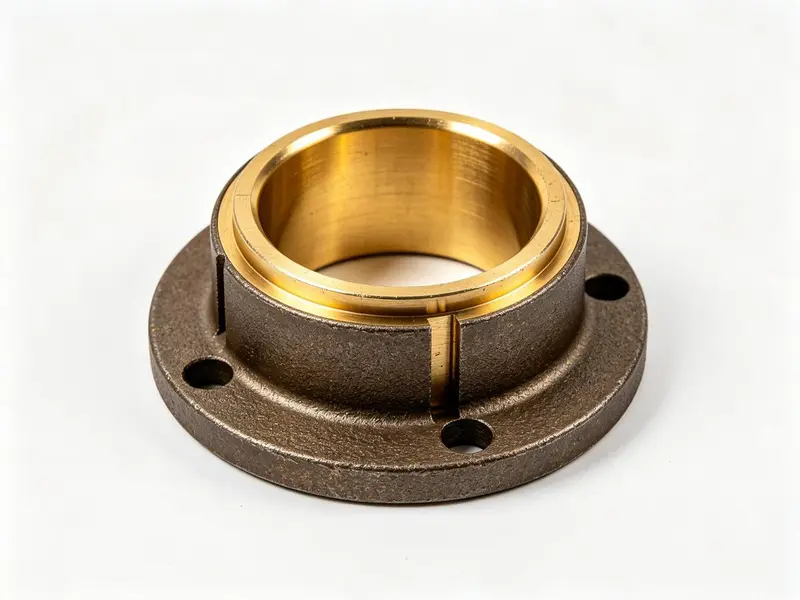
Request a Quote for C95500 Aluminum Bronze Bracket Investment Casting
Send us your requirements — we review the inquiry and prepare a quotation after drawing or requirement review.