
Aero Engine Turbine Blade Casting (Inconel 713 / K424)
Precision cast turbine blades and integral bladed wheels in Inconel 713 and K424 nickel-based superalloys for aero engine and gas turbine hot sections.
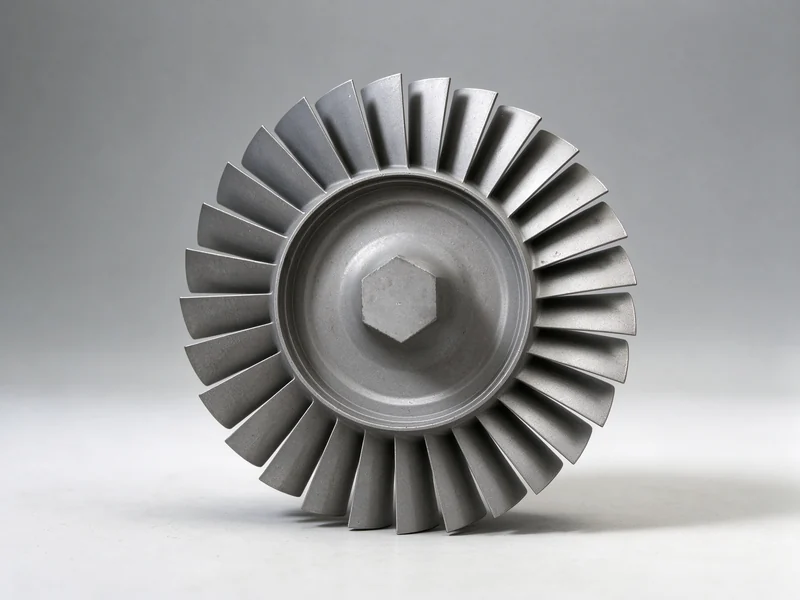
Aero Engine Turbine Blade
Precision investment cast aero engine turbine blades in Inconel 713 and K424 nickel-based superalloys. Airfoil, root and platform geometry cast to drawing, with machining and inspection coordinated for hot-section blade and bladed-wheel assemblies.
Product Specifications
| Material Grades | Inconel 713 (cast Ni-based superalloy), K424 (Ni-Cr-W-Ti-Al cast superalloy), heat-resistant steel on request |
|---|---|
| Product Category | Aerospace Castings |
| Casting Process | Investment Casting (Lost-Wax) |
| Machining Support | Machining support: Drilling, Tapping, Milling, Turning; operations arranged to approved drawings |
| Surface Finish | As-cast, sandblasted or polished finish as required; other finishing options discussed by drawing |
| Tolerance | ±0.2mm casting allowance; machining tolerance confirmed per drawing |
| Certification | ISO 9001; material records can be arranged by agreement |
| Order Quantity | Reviewed after drawing and quantity confirmation |
| Lead Time | Confirmed after drawing review and scheduling; sample timing evaluated separately |
| Customization | All castings custom made based on customer drawings |
Need a Custom Aero Engine Turbine Blade?
Send us your drawings or specifications for a free quotation after drawing or requirement review.
Get a Free Quote WhatsApp UsProduct Overview
The turbine blade is the part that extracts work from the hot gas leaving the combustor, and it is the most temperature-critical rotating component in the engine. Airfoil, root and platform are cast in one piece by investment casting, so the blade profile needs no assembly or welding; root and mating faces are then finished to the customer drawing. Blades and integral bladed wheels are produced by Wuxi Huayong Metal Technology Co., Ltd. in Inconel 713 or K424 nickel-based superalloy.
All blades are custom manufactured from customer drawings, models or samples: airfoil profile, chord and twist, root and platform geometry, and any internal passage layout shown on the drawing come from the customer design rather than a catalogue. Designs are reviewed for castability before tooling, because thin airfoil sections and a heavy root solidify at very different rates. Quality review may include chemistry records, dimensional checks and selected test methods arranged by drawing, code or order requirement.
Material Options
Blade grade selection is driven by creep and oxidation resistance more than by strength alone. Inconel 713 is a cast nickel-based superalloy hardened by gamma-prime precipitation and widely used for turbine blades and nozzle rings; K424 is a Ni-Cr-W-Ti-Al cast superalloy used in equiaxed blade and vane castings. Heat-resistant steels are reviewed only where gas temperature is low enough to make them viable. All heats are verified with spectrometer analysis, and heat treatment is agreed against the drawing or the material specification.
| Material Family | Common Grades | Key Properties | Typical Applications |
|---|---|---|---|
| Stainless Steel | CF8M, CF8, CF3M, CF3, 316L, 304L | Good corrosion resistance, good mechanical properties | Chemical, food, marine, water treatment |
| Carbon Steel | WCB, WCC, LCC, LC2 | Good strength, weldability, cost-effective | Oil & gas, power, general industrial |
| Alloy Steel | WC6, WC9, C5, C12A, 42CrMo | High temperature strength, wear resistance | Power generation, high-temp service, automotive |
| Duplex Steel | CD4MCu, CD3MN, 2205 | High strength, good pitting resistance | Oil & gas, desalination, chemical |
| Copper Alloy | C95400, C93200, C83600, Tin Bronze | Good wear resistance, corrosion resistance | Bearings, gears, marine, decorative |
| Heat Resistant | HK30, HU31, 310S, 309S | High temperature oxidation resistance | Furnace parts, heat treatment, power |
Manufacturing Process
1. Pattern Making
We produce high-precision wax patterns using injection molding. The wax patterns are exact replicas of the final turbine blade, including the airfoil, root, platform and any internal passage or cooling-feature layout shown on the drawing.
2. Shell Building
The pattern tree is repeatedly dipped into ceramic slurry and coated with refractory sand. This process is repeated 6-8 times to build a strong, heat-resistant ceramic shell.
3. Dewaxing & Preheating
The ceramic shell is placed in an autoclave where steam melts the wax, which drains out. The empty shell is then preheated to 1000-1100°C to remove residual moisture.
4. Melting & Pouring
Metal is melted in induction furnaces under carefully controlled conditions. The molten metal is poured into the preheated ceramic shells.
5. Shell Removal & Cutting
After solidification and cooling, the ceramic shell is removed by mechanical vibration and blasting. The individual components are then cut from the sprue.
6. Heat Treatment
All castings undergo proper heat treatment to achieve optimal mechanical properties and material structure.
7. Machining Support
Machining support can be arranged according to approved drawings. Critical dimensions are checked against approved drawings.
8. Surface Treatment & Testing
Finished components may include surface finishing and arranged inspection such as dimensional review and chemistry records.
Quality Control & Testing
Quality review follows the agreed order process; final condition is checked against approved drawings and specifications:
- Chemical Analysis: Spectrometer analysis of every heat; material test records can be arranged by order requirement or agreement.
- Mechanical Testing: Mechanical or hardness checks can be arranged when specified on the order
- Dimensional Inspection: Critical dimensions checked against approved drawings
- Inspection Support: Selected penetrant, radiographic or ultrasonic methods can be arranged according to drawing, code or customer requirement
- Microstructure Examination: Metallographic review can be arranged when specified on the order
- Airfoil and Section Review: Airfoil profile and section thickness checks can be arranged against the drawing or an agreed inspection plan
Applications
Turbine blades and bladed wheels serve the hot sections of aero engines and other gas turbines:
- Aero Engine Hot Section: Turbine blades and nozzle guide vanes for aero engine hot-section assemblies
- APU Turbines: Turbine blades and bladed wheels for auxiliary power unit engines
- Small Gas Turbines: Turbine rotors and blade rings for microturbines and small turbojet or turboprop engines
- Turbocharger Hot End: Radial turbine wheels and blades for turbocharger turbine stages
- Industrial Gas Turbines: Hot-section blades for power generation and mechanical drive units
- Marine Gas Turbines: Blade and vane sets for marine turbine engines
- Ground Support Equipment: Turbine blades for test stands, ground power units and starter turbines
- Repair & Overhaul: Replacement blades and bladed wheels for MRO programmes
Why Choose Huayong for Your Aero Engine Turbine Blade Castings?
- Process Coverage: Investment casting support with machining, inspection and finishing coordination
- Material Expertise: Experienced in Inconel 713, K424 and other nickel-based superalloys, plus heat-resistant and stainless grades
- ISO 9001 Quality System: Documentation and inspection records managed according to order requirements
- Custom Manufacturing: All parts made to your exact drawings and specifications
- Competitive Pricing: Factory-direct pricing with no middleman markup
- Fast Response: Quotation and technical support are arranged after requirement review.
- Hot-Section Focus: Blades, vanes and bladed wheels reviewed for aero engine and gas turbine hot-section service.
- Order Review: Prototype and production quantities reviewed after drawing review
Share this article
Ready to Start Your Project?
Send us your 2D/3D drawings, samples, or part requirements for a free custom quotation after drawing or requirement review.
Request a Quote View All ProductsEngineering Design Tips for Turbine Blade Castings
1. Airfoil Wall Thickness and Taper
The airfoil is the thinnest section of the part and the first place to run short of metal. Keep the wall as uniform as the aerodynamic profile allows, taper the trailing edge to a measurable minimum instead of a knife edge, and expect the as-cast airfoil surface to stay unmachined.
2. Root and Platform Sections
The root is the heaviest section and the airfoil the lightest, so the joint between them controls shrinkage porosity. Use generous fillets at the root transition, and avoid a thick platform boss sitting directly against a thin wall.
3. Internal Passages and Core Stability
Where the design includes internal passages, the ceramic core sets the wall thickness and cannot move during pouring. State the minimum wall and the core-print areas on the drawing, and agree how core shift will be judged before tooling.
4. Machining Allowance at Root and Tip
Allow 2-3 mm on the root, platform and any location faces, but leave the airfoil and gas-path surfaces as-cast. Adding allowance to the airfoil changes the profile and the throat area.
5. Superalloy Castability, Grain and Heat Treatment
Nickel-based superalloys are stiff at pouring temperature and crack easily in thin sections. State the heat treatment and any grain-structure requirement on the drawing, and agree the inspection level (penetrant, radiographic, dimensional) before the pattern is cut.
Frequently Asked Questions
Q: Should I specify Inconel 713 or K424?
A: Both are cast nickel-based superalloys used for turbine blades and vanes. Inconel 713 relies on gamma-prime precipitation for high-temperature strength; K424 is a Ni-Cr-W-Ti-Al cast superalloy used in equiaxed blade and vane castings. The choice normally follows the drawing, the gas temperature and the qualified material list of the end user.
Q: Can blades be cast from a 3D model instead of a 2D drawing?
A: Yes. Models and drawings are both reviewed; the airfoil definition, datum scheme and inspection points are agreed before tooling so that cast and machined features are checked against the same reference.
Q: Do you cast single blades or complete bladed wheels?
A: Both. Single turbine blades are cast individually; bladed wheels and bladed discs are cast as one piece with integral blades, then the bore and locating faces are machined. The choice is set by the customer design.
Q: What inspection can be arranged on superalloy blades?
A: Chemistry, dimensional and selected penetrant or radiographic inspection can be arranged according to the drawing, code or order requirement; records are prepared under the ISO 9001 quality system.
Q: What is the minimum order quantity?
A: Order quantity is project-dependent: tooling is made once, then production quantities are agreed after drawing review.
Related Products
Request a Quote for Aero Engine Turbine Blade Casting
Send us your requirements — we review the inquiry and prepare a quotation after drawing or requirement review.