
CA104 Aluminum Bronze Pump Casing Investment Casting
Pump casings investment cast in CA104 aluminum bronze (CuAl10Fe5Ni5) for seawater, chemical and general fluid duty, with the bore, flange faces and mounting holes machined to customer drawing.
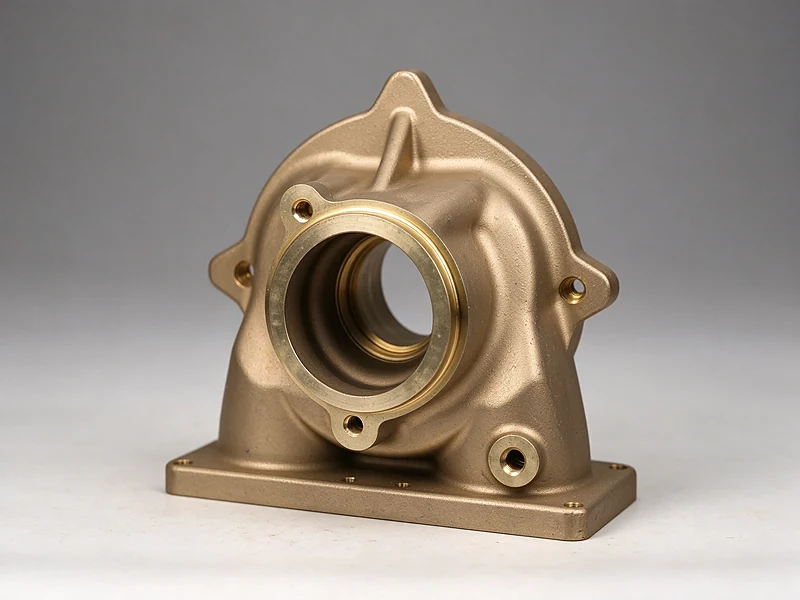
Aluminum Bronze Pump Casing
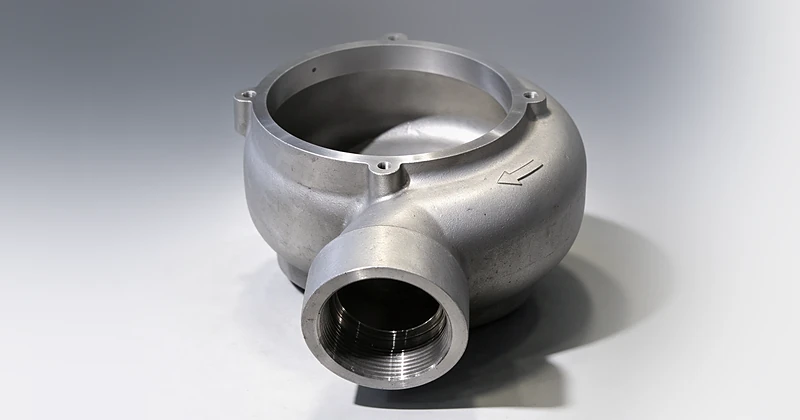
Investment-cast pump casing in CA104 aluminum bronze, with the volute, suction eye flange, discharge pad, external ribs and base plate produced as one casting. The suction bore, flange faces and base mounting holes are machined to approved drawings for seawater, chemical and general fluid pumps.
Product Specifications
| Material Grades | CA104 Aluminum Bronze (CuAl10Fe5Ni5); ZCuAl10Fe3 option |
|---|---|
| Product Category | Pump Components / Copper Alloy Castings |
| Casting Process | Investment Casting (Lost-Wax) |
| Geometry | Volute casing with suction eye flange, discharge pad, external reinforcing ribs and a rectangular base plate with bolt holes; bore size, flange centres and base layout defined by customer drawing |
| Machining Support | Turning, Boring, Milling, Drilling; suction bore, flange faces, base plate face and mounting holes finished to approved drawings |
| Surface Finish | As-cast with machined faces; sandblasted, polished or shot-blasted where specified by drawing |
| Tolerance | ±0.2mm casting allowance; bore roundness, flange squareness and base flatness checked at final inspection |
| Certification | ISO 9001; material records can be arranged by agreement |
| Order Quantity | Reviewed after drawing and quantity confirmation |
| Lead Time | Confirmed after drawing review and scheduling; sample timing evaluated separately |
| Customization | All castings custom made based on customer drawings |
Need a Custom Aluminum Bronze Pump Casing?
Send us your drawings or specifications for a free quotation after drawing or requirement review.
Get a Free Quote WhatsApp UsProduct Overview
This is a volute casing for a centrifugal pump, investment cast in CA104 aluminum bronze (CuAl10Fe5Ni5). The volute, suction eye flange, discharge pad, external ribs and base plate are poured as one casting, so the pressure boundary has no joint and the casing carries its own mounting feet.
Aluminum bronze is used where a stainless or cast iron casing will not hold up: seawater, brine, chloride-bearing process liquid and mildly acidic duty. CA104 is a nickel-bearing grade, so it resists chloride attack and cavitation erosion at the volute throat better than the nickel-free aluminum bronzes, and it does not suffer the dezincification that brass casings do.
The casting is poured oversize on the surfaces that matter and then machined: the suction bore, the discharge flange face, the base plate face and the mounting holes. Bore size, flange centres, wall thickness and rib layout are fixed by the customer drawing.
Geometry & Construction
As shown, the casing has a circular volute body with radiating fins on the outside wall, a suction eye flange on the front face with a machined bore and a ring of bolt pads, a discharge pad on the upper side, and a rectangular base plate at the bottom with four mounting holes. The model in the photograph is one size of this casing family, as-cast on the outside and machined on the eye face and bore.
Wall section, rib layout, base plate thickness and machining stock come from the drawing. Three points are reviewed before the pattern is cut:
- Wall section through the volute: the volute wall has to stay thick enough to hold pump pressure and thin enough to feed; where the wall meets the suction eye flange the sections stack, so the transition is bled and checked on the first article rather than adjusted later.
- Feeding the eye flange and base plate: the flange and the base plate are the two heaviest sections in the part, and both are on the outside of a thin volute. Gating and risers are laid out so those two sections stay fed and no shrinkage opens on a machined face.
- Machining stock and set-up: the suction bore has to end up concentric with the volute and square to the eye face, so stock is left on the eye face, the bore and the base plate; the fixturing for that set-up is planned before the first casting is poured.
Material Options: Two Aluminum Bronzes
Both grades are cast aluminum bronzes for pump casings; the difference is nickel and how much chloride the casing sees. Grade, temper and test requirements follow the drawing designation.
| Grade | Reference | Key Properties | Typical Fit |
|---|---|---|---|
| CA104 | CuAl10Fe5Ni5; Al 8.5-11%, Fe 4-6%, Ni 4-6% | Nickel-bearing aluminum bronze; high strength with good resistance to seawater, chloride attack and cavitation erosion, non-magnetic and non-sparking | Seawater, brine, chemical and marine pump casings, impellers and valves |
| ZCuAl10Fe3 | GB/T 1176 ZCuAl10Fe3 (EN CuAl10Fe2); Al 8.5-11%, Fe 2-4% | Nickel-free iron aluminum bronze; good strength and wear resistance at lower alloy cost, with corrosion resistance suited to lower-chloride duty | Fresh water, general fluid transfer and wear-loaded casings where chloride stays low |
CA104 is the default where the casing is wetted by seawater or chloride-bearing product, because the nickel content is what holds up at the volute throat and on the machined eye face. ZCuAl10Fe3 is used where the duty is fresh water or a mild fluid and cost has to be held, and it machines more easily. Chemistry is checked per heat, and PMI or spectrometer records are arranged to order requirement.
Casting and Machining Process
1. Drawing Review & Mould Layout
Wall sections, flange centres, rib layout, base plate thickness and machining allowance on the eye face and bore are checked against the drawing, and gating and risers are laid out before the pattern is cut.
2. Pattern & Shell
Wax patterns are injected with the volute, eye flange, ribs and base plate in one piece, gates are attached and the ceramic shell is built and dried in controlled steps.
3. Melting & Pouring
Heat is melted to the drawing grade and poured at a temperature set for the wall section, with the heavy flange and base sections fed through the gating. Chemistry and pour records are kept per heat.
4. Knock-Out & Cleaning
Shell is removed, gates and runners are cut off, and the casting is cleaned and inspected for surface defects before machining.
5. Machining
The suction eye face is machined flat and the bore is turned concentric with the volute, the discharge flange face is faced square, and the base plate face and mounting holes are finished to the drawing's dimensions.
6. Surface Preparation
The casing is cleaned and blasted to the finish called for by the drawing; machined faces are protected through handling so no burrs or dents reach the customer.
7. Inspection
Bore size and roundness, flange squareness, base flatness, mounting hole positions and wall thickness are checked against the drawing, and casting soundness is reviewed before packing.
8. Packing
Casings are packed so flange faces and the machined bore are not loaded in transit, and the base plate is not used as the bearing surface in the crate.
Quality Control & Testing
Inspection follows the agreed order process; the finished casting is checked against approved drawings and specifications:
- Material Identification: heat records per lot; PMI or spectrometer check where the order requires it
- Casting Soundness: visual check of the volute, eye flange and base plate, with penetrant or radiographic inspection arranged where specified
- Dimensional Inspection: bore size and roundness, eye face and discharge flange squareness, base flatness, mounting hole positions and overall envelope checked against the drawing
- Surface Condition: as-cast surface and machined faces checked before packing; Ra verified where the drawing specifies it
- Documentation: material, dimensional and inspection reports kept per order; third-party inspection can be arranged where applicable
Applications
- Marine and shipboard pumps: seawater cooling, ballast and fire pumps where the casing is wetted continuously
- Desalination and brine duty: casings on high-chloride streams where nickel-free bronzes corrode too fast
- Chemical process pumps: chloride-bearing and mildly acidic product where a bronze casing is specified
- Water treatment: dosing, transfer and circulation pumps in plant duty
- Power and offshore: sea-water and lube service pumps on skids and packages
- General fluid transfer: any bronze casing required by drawing where a non-sparking, non-magnetic part is specified
Design Notes for Bronze Pump Casings
- Pressure duty and wall section: state the design pressure and the minimum wall through the volute; a casing poured to a thin wall cannot be corrected by machining, and a heavy wall at the eye flange needs a fed section.
- Bore and flange relationship: give the bore diameter, the eye face position and the squareness tolerance to the discharge flange, because the two faces are set up in one operation and the tolerance drives the fixturing.
- Machining stock: leave stock on the eye face, bore and base plate; castings that are poured to net size cannot be trued after the pour.
- Rib layout: say whether the external ribs are required for stiffness or for handling, since rib position affects feeding and the as-cast appearance the customer inspects.
- Grade and test: name the grade on the drawing and state whether PMI, penetrant or radiographic inspection is required, so the test is built into the route rather than added afterwards.
- Surface finish: state the as-cast finish, whether blasting applies and the Ra on machined faces; a blasted casting cannot be brought back to a polished look afterwards.
- Marking: specify where the part number, heat code and grade mark go, and keep that position off the machined faces.
Why Choose Huayong for Aluminum Bronze Pump Casing Casting?
- Copper alloy casting: aluminum bronze poured in-house with gating laid out for the eye flange and base plate, so heavy sections stay fed
- Material coverage: CA104 and ZCuAl10Fe3, with grade confirmed against the drawing before the heat is melted
- Machining in-house: eye face, bore, discharge flange and base mounting holes finished to approved drawings in one set-up
- Mould review first: wall section, feeding of the heavy sections and machining stock checked before the pattern is cut
- Documentation: heat, dimensional and inspection records managed according to order requirements
- Factory-direct supply: custom castings produced to customer drawings without intermediary markup
Ready to Start Your Project?
Send us your 2D/3D drawings, samples, or pump casing requirements for a free custom quotation after drawing or requirement review.
Request a Quote View All ProductsEngineering Design Tips for Precision Castings
1. Wall Thickness Design
Maintain uniform wall thickness throughout the casting to minimize shrinkage porosity and thermal stress during solidification. Avoid abrupt section changes; use gradual transitions with fillet radii of at least 2-3mm. Minimum wall thickness for investment casting is typically 2mm for small parts and 3mm for larger components.
2. Draft Angles
Design with minimum 1° draft angle for external surfaces and 1.5° for internal surfaces to facilitate wax pattern removal from the die and ceramic shell breakdown. Deeper features may require additional draft.
3. Fillet Radii
Always use generous fillet radii at internal corners (minimum R2-3mm) to reduce stress concentration and improve castability. Sharp corners are prone to cracking and porosity during solidification.
4. Machining Allowance
Allow 2-3mm machining allowance per surface for machining operations. Critical sealing surfaces and precision bores may require additional allowance. Machining tolerance requirements should be reviewed against approved drawings; as-cast allowance is confirmed by drawing and casting complexity.
5. Surface Finish Considerations
Investment casting provides Ra 1.6-3.2μm as-cast surface finish. For applications requiring smoother surfaces, specify polishing, electropolishing, or machining in the drawing requirements.
Frequently Asked Questions
Q: What materials can you cast?
A: We work with stainless steel (304, 316, CF8, CF8M), carbon steel (WCB), alloy steel, duplex steel (2205), heat-resistant alloys, copper alloys, and specialty alloys. Custom compositions available per specification.
Q: What is the typical lead time?
A: Lead time is confirmed after drawing review and scheduling; sample and production timing are evaluated separately.
Q: Can you provide material test certificates?
A: Every heat can be reviewed with spectrometer analysis. Material records, certificates and inspection items are arranged according to the drawing, code or order requirement; third-party inspection can be requested where applicable.
Q: What is the minimum order quantity?
A: Order quantity, tooling cost and pricing are reviewed after drawing and quantity confirmation.
Q: Do you offer machining support services?
A: Yes, post-machining support can include turning, milling, drilling, tapping and grinding; finished component readiness is confirmed per drawing and order requirements.
Related Products
Request a Quote for CA104 Aluminum Bronze Pump Casing Investment Casting
Send us your requirements — we review the inquiry and prepare a quotation after drawing or requirement review.