
Mechanical Connection Bracket / Lock Block Investment Casting
Investment cast stainless connection brackets and lock blocks in 304, 316 and 316L, cast with the hook, pin boss and pocket in place, then machined and drilled to drawing.
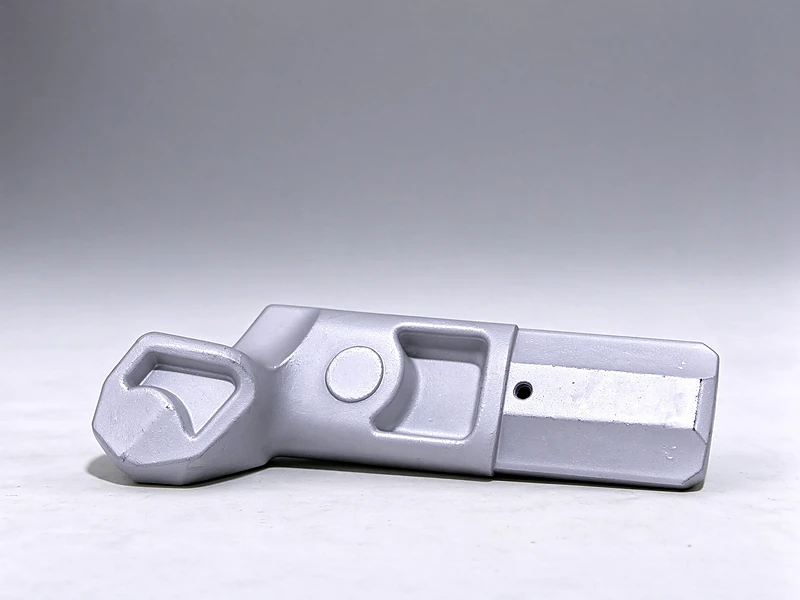
Mechanical Connection Bracket / Lock Block Casting
This mechanical connection bracket, also supplied as a lock block or latch arm, is a single stainless steel investment casting in 304, 316 or 316L. The hook end, the raised pin boss, the side pocket and the square shank are formed in the wax pattern and cast in one piece, so the part does not depend on a welded or bolted joint at the hook. The boss face and OD, the shank flats and the lock hole are then machined to drawing, and the hook is finished to the radius and section the drawing specifies. 304 covers general mechanical duty, while 316 and low-carbon 316L are used for washdown, chloride exposure and assemblies that are welded after casting. For other plate and bracket work, see our investment cast cover plate and base plate castings.
Product Specifications
| Material Grades | 304 / 316 / 316L austenitic stainless; 2205 and 17-4PH on request |
|---|---|
| Product Category | Mechanical Connection Bracket / Lock Block / Latch Arm Component |
| Casting Process | Investment Casting (Lost-Wax / Silica Sol Shell Stainless Steel Casting) |
| Machining Support | Machining support: boss face and OD, pocket floor, shank flats and squareness, chamfers and drilled lock hole; operations arranged to approved drawings |
| Surface Finish | As-cast, shot blasted, machined stainless finish, pickled or passivated as required |
| Tolerance | Casting tolerance typically ±0.2mm; boss position, shank squareness and hole position controlled to drawing tolerance |
| Certification | Chemistry, dimensional and penetrant records can be arranged when required |
| Order Quantity | Reviewed after drawing and quantity confirmation |
| Lead Time | Confirmed after drawing review and scheduling; sample timing evaluated separately |
| Customization | Custom length, hook form, boss position, pocket depth, shank section, hole layout, material grade and finish according to drawings or samples |
Need a Custom Bracket or Lock Block?
Send us your drawings, samples or service conditions for a quotation after drawing or requirement review.
Get a Free Quote WhatsApp UsProduct Overview
This bracket is a custom investment casting supplied by Wuxi Huayong Metal Technology Co., Ltd. Overall length, hook radius, hook opening, boss diameter and position, pocket depth, shank section and hole position are taken from the customer's drawing or 3D model, reproduced in the wax pattern and cast as a single piece, with machining allowance left only on the faces the drawing marks as machined.
Before tooling, the section change between the hook, the centre body and the square shank is reviewed, because the centre body is the heaviest section and cools last while the hook is thin and cools first; an unbalanced layout there pulls the shank out of square and shifts the hole after drilling. Gate position, feeding, pocket depth and core removal from the hook opening are agreed at the same time. 304 covers general mechanical duty; 316 adds molybdenum for washdown and chloride exposure, and 316L, with its lower carbon, is the choice when the bracket is welded into a frame after casting.
Material Options
This page covers the three austenitic stainless grades most often specified for connection brackets and lock blocks. Duplex and precipitation-hardening grades follow where load or wear calls for them; the table below lists the families we cast most often for this type of part.
| Material Family | Common Grades | Key Properties | Typical Applications |
|---|---|---|---|
| 304 Austenitic Stainless | 18-8 Cr-Ni, cast equivalent CF8 | General corrosion resistance, good ductility and weldability | General mechanical brackets, guards, non-chloride washdown |
| 316 Austenitic Stainless | 16-18% Cr with 2-3% Mo, cast equivalent CF8M | Molybdenum-bearing resistance to chlorides and washdown chemicals | Food equipment, marine-adjacent fixtures, chemical plant hardware |
| 316L Low-Carbon Stainless | 316L, cast equivalent CF3M | Low carbon limits carbide precipitation at weld seams and heavy sections | Brackets welded into frames, sanitary and pharma fixtures |
| Duplex / PH on request | 2205, 17-4PH | Higher strength and pitting resistance; 17-4PH adds hardness | High-load latch blocks, wear-prone lock parts |
Manufacturing Process
1. Pattern Making
The wax pattern carries the hook opening, the pin boss, the pocket and the square shank, with allowance left only on the boss face, shank flats and hole location, so the cast shape stays close to the finished part.
2. Shell Building
The pattern tree is dipped in ceramic slurry and staved with refractory sand, 6-8 times over, until the shell is strong enough to hold the thin hook section and the pocket edge without cracking during pouring.
3. Dewaxing & Preheating
The shell goes into an autoclave where steam melts the wax and drains it out; the empty shell is then preheated to 1000-1100°C so the metal fills the hook and pocket cleanly.
4. Melting & Pouring
304, 316 or 316L charges are melted under controlled chemistry and checked on the spectrometer before pouring; carbon is held low on 316L heats so the low-carbon grade is kept, and pouring temperature is set to suit the thin hook wall.
5. Shell Removal & Cutting
After solidification the ceramic shell is broken off by vibration and blasting, and the parts are cut from the sprue, with the gate witness left on a non-functional face where the drawing allows.
6. Heat Treatment
Castings receive the solution anneal called for by the grade before machining, so the austenitic structure is uniform and the part does not move between the boss and shank operations.
7. Machining Support
Machining can be arranged to approved drawings: boss face and boss OD, pocket floor, shank flats and squareness, chamfers, and the lock hole drilled and reamed to position.
8. Surface Treatment & Testing
Brackets may be supplied as-cast and shot blasted, or machined, pickled and passivated, which is usual for 316L washdown parts; inspection covers dimensions, chemistry, and penetrant testing at the hook root and boss.
Quality Control & Testing
Quality control follows the bracket from melt chemistry to final hole check:
- Chemical Analysis: Spectrometer verification of the 304, 316 or 316L heat, with carbon checked on 316L and molybdenum checked on 316, and material records prepared by agreement when ordered.
- Mechanical and Hardness Check: Tensile, yield, elongation and hardness records as applicable to the selected grade and inspection standard.
- Dimensional Check: Overall length, hook opening and radius, boss diameter and position, pocket depth, shank section and hole position checked against the drawing.
- Surface and Defect Inspection: Visual inspection and dye penetrant testing at the hook root, boss fillet and pocket edges, with radiographic testing arranged where the drawing calls for it.
- Fit and Function Check: Pin and hole fit, and a mating check against the mating part or gauge where a sample or fixture is supplied with the order.
- Documentation Traceability: Heat number, inspection records, material certificate, packing list and shipping documents can be organized with each batch.
Applications
A connection bracket or lock block of this shape is used where a cast arm has to hook, pivot or lock, and the grade has to suit the environment:
- Latch and Lock Mechanisms: Arms that hook a pin or bar and lock it in position on doors, covers and access panels.
- Clamp and Fixture Frames: Arms and blocks that hold workpieces or tooling in welding and assembly fixtures.
- Machine Guards and Covers: Brackets that carry guards, covers and safety panels on packaging and process machinery.
- Food and Pharma Washdown Fixtures: 316 and 316L parts for frames and latches cleaned with washdown chemicals.
- Marine and Offshore Hardware: Brackets for deck fittings and hatch hardware, with duplex reviewed where chloride load is high.
- Conveyor and Linkage Arms: Cast arms in mechanical linkages where a welded joint at the hook would be a weak point.
- Replacement and Rebuild Parts: Spares cast and machined to sample for existing machines and imported equipment.
Why Choose Huayong
- 304, 316 and 316L Quoted Side by Side: Three grades quoted together so the service environment picks the alloy.
- Hook and Pocket Cast In Place: The hook opening and pocket come out of the mould, so the part does not depend on a welded or brazed joint at the load point.
- Casting and Machining Together: From wax pattern and ceramic shell to boss face, shank flats and drilled lock hole.
- Distortion Control on Mixed Sections: Gate and feeding reviewed where a heavy centre body sits between a thin hook and a square shank.
- Low-Carbon Option for Welded Frames: 316L is held low in carbon where the bracket is welded into a frame after casting.
- Surface Preparation: Shot blasting, pickling and passivation arranged where washdown or appearance matters.
- Flexible Quantity: Prototypes, development batches and serial production can be quoted from drawings and annual demand.
- Factory Direct Response: Technical quotation prepared after drawing review from drawings, samples or duty conditions.
Ready to Start Your Project?
Send us your 2D/3D drawings, samples, or bracket and lock block requirements for a quotation after drawing or requirement review.
Request a Quote
View All Products
Ready to Start Your Project?
Send us your 2D/3D drawings, samples, or bracket and lock block requirements for a quotation after drawing or requirement review.
Request a Quote View All ProductsEngineering Design Tips for Connection Brackets and Lock Blocks
1. Grade Selection: 304, 316 or 316L
Use 304 for general mechanical duty; step to 316 where washdown chemicals or chlorides are present, and to 316L when the bracket is welded into a frame after casting or the section is heavy. Carbon level, not just the alloy name, decides whether the weld seam stays clean.
2. Hook, Opening and Thin Sections
The hook is the thinnest section of the part and the one that carries the load. Keep a generous radius at the hook root, taper the section from the hook into the body instead of stepping it, and let the drawing state whether the hook opening is cast or cut, because a cast opening needs a core that can be removed cleanly.
3. Boss, Pocket and Shank Datum
The boss face and the shank flats are the datums for every later operation. Put a clear drawing callout on the boss position relative to the shank, keep the pocket floor off the datum faces, and avoid sharp internal corners at the pocket, which is where stainless is most likely to tear during casting.
4. Lock Hole and Pin Fit
Drill the lock hole after casting rather than forming it in the mould: hole position, diameter tolerance and reaming allowance are far easier to hold in a fixture. State the pin diameter and the fit class on the drawing so the hole is sized for the pin, not for a nominal drill.
5. Stainless Machining and Passivation
304, 316 and 316L work-harden and smear rather than cut cleanly, and a thin hook deflects under clamping. Sharp tooling, controlled feeds and light finishing cuts keep the boss true and the shank square; passivation after machining restores the surface film on 316L parts used in washdown areas.
Frequently Asked Questions
Q: What is the difference between 304, 316 and 316L for this part?
A: 304 is the general-purpose austenitic grade for mechanical duty. 316 adds molybdenum for washdown chemicals and chlorides. 316L is the low-carbon version of 316, chosen where the bracket is welded after casting or the section is heavy enough for carbide precipitation to matter at a weld seam.
Q: Can the hook and pocket be cast instead of machined?
A: Yes. The hook opening, the chamfered hook head, the pocket and the shank are formed in the wax pattern, so they come out of the shell as cast features. Machining is then limited to the boss face, the shank flats, chamfers and the lock hole, which keeps cost down on a part with a lot of surface.
Q: Can you supply the bracket machined with the lock hole drilled?
A: Yes. Boss face and OD, pocket floor, shank flats and squareness, chamfers, and the drilled and reamed lock hole can all be machined after casting to the approved drawing, and inspection records can be prepared by agreement when ordered.
Q: Can you reverse-engineer an existing bracket or lock block?
A: Send a sample, a worn part, an old drawing or the machine model it fits. We can review the hook section, boss position and hole layout, propose a casting approach, make tooling, supply sample castings and machine to the approved drawing.
Related Products
Request a Quote for Mechanical Connection Bracket / Lock Block Investment Casting
Send us your requirements — we review the inquiry and prepare a quotation after drawing or requirement review.