
Centrifugal Pump Impeller Casting (C95500 / Tin Bronze)
Investment cast closed impellers in C95500 aluminum bronze and tin bronze for seawater, marine and chemical pump service.
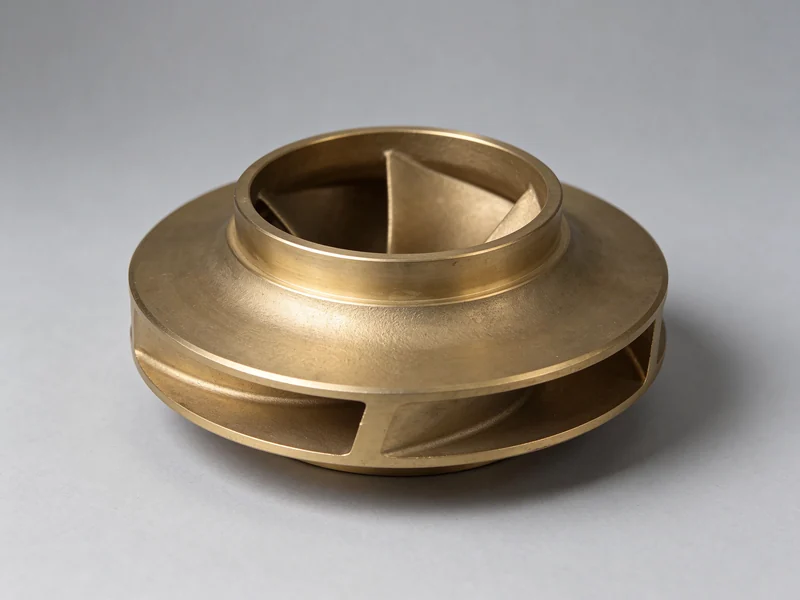
Bronze Centrifugal Pump Impeller
Investment cast closed centrifugal pump impellers in C95500 aluminum bronze and tin bronze. Integral blades, annular flow channel and central shaft bore, with CNC machining and dynamic balancing arranged on request for seawater and marine pump duty.
Product Specifications
| Material Grades | C95500 aluminum bronze (UNS C95500), tin bronze per customer specification, other copper alloys on request |
|---|---|
| Product Category | Pump Components |
| Casting Process | Investment Casting (Lost-Wax) |
| Machining Support | Machining support: Drilling, Tapping, Milling, Turning; operations arranged to approved drawings |
| Surface Finish | As-cast, sandblasted or polished finish as required; other finishing options discussed by drawing |
| Tolerance | ±0.2mm casting allowance; machining tolerance confirmed per drawing |
| Certification | ISO 9001; material records can be arranged by agreement |
| Order Quantity | Reviewed after drawing and quantity confirmation |
| Lead Time | Confirmed after drawing review and scheduling; sample timing evaluated separately |
| Customization | All castings custom made based on customer drawings |
Need a Custom Bronze Pump Impeller?
Send us your drawings or specifications for a free quotation after drawing or requirement review.
Get a Free Quote WhatsApp UsProduct Overview
The closed impeller is the part that does the work in a centrifugal pump. The shaft drives the hub, the shrouded annular channel carries the liquid outward, and the head and flow are set by the blade angle and the passage area. On the closed type the front and rear shrouds enclose the blades, so the flow stays inside the impeller instead of slipping past an open blade tip. Impellers are produced by Wuxi Huayong Metal Technology Co., Ltd. by investment casting in C95500 aluminum bronze or tin bronze, with the shaft bore, keyway and faces finished to the customer drawing.
Every impeller is custom made to customer drawings or samples: suction eye diameter, blade count and exit angle, shroud profile, shaft bore and keyway come from the customer design rather than a catalogue. Designs are reviewed for castability before tooling, because bronze pours cooler than steel and thin blade sections set quickly. Features that must run concentric or need balancing are identified at the drawing stage, so machining and balancing can be planned together with the casting.
Material Options
Bronze is chosen for pump parts because it combines corrosion resistance with a surface that does not gall against seawater. UNS C95500 nickel-aluminum bronze is the grade normally used for seawater and marine duty: it resists chloride attack, resists cavitation erosion at the impeller eye and keeps useful strength in warm brine. Tin bronze suits clean water and lower-duty service, and other copper alloys can be reviewed on request. Blade angle, passage area and surface roughness decide efficiency far more than alloy choice once the medium is compatible.
Impeller grade guide: C95500 aluminum bronze and tin bronze are the grades covered on this page. C95800 nickel aluminum bronze impellers: C95800 bronze pump impeller. Stainless and duplex impellers: stainless steel centrifugal pump impeller. The single-grade 316L closed design: closed pump impeller.
| Material Family | Common Grades | Key Properties | Typical Applications |
|---|---|---|---|
| Stainless Steel | CF8M, CF8, CF3M, CF3, 316L, 304L | Good corrosion resistance, good mechanical properties | Chemical, food, marine, water treatment |
| Carbon Steel | WCB, WCC, LCC, LC2 | Good strength, weldability, cost-effective | Oil & gas, power, general industrial |
| Alloy Steel | WC6, WC9, C5, C12A, 42CrMo | High temperature strength, wear resistance | Power generation, high-temp service, automotive |
| Duplex Steel | CD4MCu, CD3MN, 2205 | High strength, good pitting resistance | Oil & gas, desalination, chemical |
| Copper Alloy | C95400, C93200, C83600, Tin Bronze | Good wear resistance, corrosion resistance | Bearings, gears, marine, decorative |
| Heat Resistant | HK30, HU31, 310S, 309S | High temperature oxidation resistance | Furnace parts, heat treatment, power |
Manufacturing Process
1. Pattern Making
We produce high-precision wax patterns using injection molding. The wax patterns are exact replicas of the final closed impeller, including the annular flow channel between the shrouds and the blade passages that cannot be reached by machining afterwards.
2. Shell Building
The pattern tree is repeatedly dipped into ceramic slurry and coated with refractory sand. This process is repeated 6-8 times to build a strong, heat-resistant ceramic shell.
3. Dewaxing & Preheating
The ceramic shell is placed in an autoclave where steam melts the wax, which drains out. The empty shell is then preheated to 1000-1100°C to remove residual moisture.
4. Melting & Pouring
Metal is melted in induction furnaces under carefully controlled conditions. The molten metal is poured into the preheated ceramic shells.
5. Shell Removal & Cutting
After solidification and cooling, the ceramic shell is removed by mechanical vibration and blasting. The individual components are then cut from the sprue.
6. Heat Treatment
All castings undergo proper heat treatment to achieve optimal mechanical properties and material structure.
7. Machining Support
Machining support can be arranged according to approved drawings: shaft bore, keyway, faces and sealing diameters are finished to drawing, and dynamic balancing can be arranged to the grade stated on the order. Critical dimensions are checked against approved drawings.
8. Surface Treatment & Testing
Finished components may include surface finishing and arranged inspection such as dimensional review and chemistry records.
Quality Control & Testing
Quality review follows the agreed order process; final condition is checked against approved drawings and specifications:
- Chemical Analysis: Spectrometer analysis of every heat; material test records can be arranged by order requirement or agreement.
- Mechanical Testing: Mechanical or hardness checks can be arranged when specified on the order
- Dimensional Inspection: Critical dimensions checked against approved drawings
- Inspection Support: Selected penetrant, radiographic or ultrasonic methods can be arranged according to drawing, code or customer requirement
- Microstructure Examination: Metallographic review can be arranged when specified on the order
- Flow Channel Review: Blade thickness and passage continuity can be reviewed against the drawing or an agreed inspection plan
- Pressure Testing: Hydrostatic or pneumatic pressure tests can be arranged for pressure-containing castings when specified
Applications
Bronze impellers are used where the pumped medium attacks steel and where cavitation risk is high:
- Seawater Pumps: Impellers for seawater intake, ballast, cooling and fire-main pumps
- Marine & Offshore: Engine room, deck and offshore platform seawater services
- Chemical & Process: Corrosive and mildly abrasive media in process pumps
- Clean Water Supply: Municipal and industrial clear-water transfer and boosting
- Desalination: Brine and seawater stages of thermal and membrane plants
- Irrigation & Drainage: Agricultural and flood-control pumping stations
- HVAC & Building Services: Chilled-water and condenser-water circulation pumps
- Fire Fighting: Bronze impellers for fire pumps and hydrant systems
Why Choose Huayong for Your Bronze Pump Impeller Castings?
- Process Coverage: Investment casting support with machining, inspection and finishing coordination
- Material Expertise: Experienced in aluminum bronze C95500, tin bronze and other copper alloys, plus stainless and duplex grades
- ISO 9001 Quality System: Documentation and inspection records managed according to order requirements
- Custom Manufacturing: All parts made to your exact drawings and specifications
- Competitive Pricing: Factory-direct pricing with no middleman markup
- Fast Response: Quotation and technical support are arranged after requirement review.
- Flow-Path Quality: Integral blades and a smooth as-cast passage reduce the need to finish the channel after casting.
- Order Review: Prototype and production quantities reviewed after drawing review
Share this article
Ready to Start Your Project?
Send us your 2D/3D drawings, samples, or part requirements for a free custom quotation after drawing or requirement review.
Request a Quote View All ProductsEngineering Design Tips for Bronze Impeller Castings
1. Blade Thickness and Flow Channel Width
Keep the blades between 3 and 8 mm and the channel between the shrouds wide enough to fill before the metal skins over. A passage narrower than about 4 mm at the exit is the first place to run short of metal on a closed impeller.
2. Suction Eye and Shroud Profile
The suction eye sets the inlet velocity and the shrouds set the disc friction. Profile the eye with a generous radius at the shroud junction, and give the shroud a smooth thickness transition toward the hub instead of a step.
3. Shaft Bore, Keyway and Hub
Bore and keyway are machined after casting, so leave 2-3 mm on the bore and keep the hub wall thick enough to hold the key without distortion. State the fit class and the keyway standard on the drawing.
4. Machining Allowance and Balance
Allow machining stock on the bore, faces, sealing diameters and any balancing planes, but leave the shrouds and the internal channel as-cast. Balance is judged on the machined part, so state the grade and the correction planes up front.
5. Bronze Castability and Section Changes
Copper alloys pour cooler than steel and shrink more, so abrupt section changes between the hub, shroud and blades pull the casting. Use generous fillets at the blade-to-shroud junction and agree the gating direction before the pattern is cut.
Frequently Asked Questions
Q: C95500 aluminum bronze or tin bronze — which should I specify?
A: C95500 nickel-aluminum bronze is the usual choice for seawater and marine duty: it resists chloride attack and cavitation erosion at the impeller eye. Tin bronze suits clean water and lower-duty service. The final choice normally follows the pump duty point, the pumped medium and the end user material list.
Q: Can the impeller be dynamically balanced?
A: Dynamic balancing can be arranged to the balance grade stated on the drawing or in the order, normally after machining. State the grade and the balancing planes; balancing without a stated grade is not assumed.
Q: Closed, semi-open or open impeller?
A: This page covers the closed type, where front and rear shrouds enclose the blades. Semi-open and open impellers are cast as separate designs; the choice is set by the solids in the medium and the required efficiency.
Q: Will the as-cast flow channel need machining?
A: Normally no. Investment casting gives a smooth as-cast passage between the shrouds, which is what the cast impeller is chosen for. The shaft bore, keyway, faces and any sealing diameters are machined; internal channel finishing is reviewed only where the drawing calls for it.
Q: What is the minimum order quantity?
A: Order quantity is project-dependent: tooling is made once, then production quantities are agreed after drawing review.
Related Products
Request a Quote for Bronze Centrifugal Pump Impeller Casting
Send us your requirements — we review the inquiry and prepare a quotation after drawing or requirement review.