
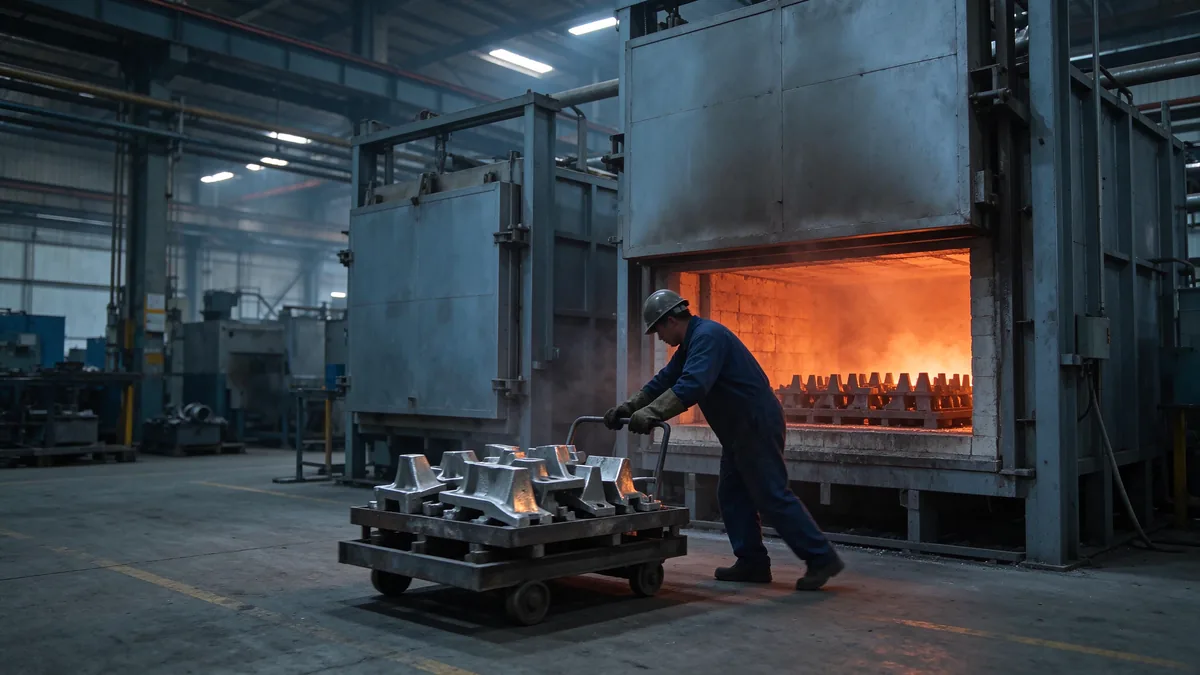
The 30-Second Summary
Heat treatment is not an optional finishing step bolted onto casting. For most austenitic stainless castings it is written into the material standard, and skipping it changes the alloy you deliver: an as-cast CF8M that never saw a solution anneal can look correct, machine cleanly and still fail in chloride service because its chromium is tied up in grain-boundary carbides. Three treatments do most of the work. Solution annealing dissolves secondary phases and restores corrosion resistance. Stress relief removes the residual stress that otherwise turns into distortion during machining. Aging raises hardness in the precipitation-hardening grades. Duplex and super duplex grades follow their own rule, and getting it wrong is a metallurgical failure rather than a paperwork problem.
What Heat Treatment Actually Changes
A casting comes out of the shell with a dendritic, cored microstructure. In the mould the metal cools at a rate set by section thickness, so a thick flange and a thin rib solidify under different conditions and finish with different grain structures. Alloying elements segregate between dendrite cores and boundaries, and residual stress builds up wherever one part of the casting contracts before another.
Heat treatment attacks three of those consequences:
- Homogenisation. A hold at high temperature lets the segregated elements diffuse and reduces the chemical difference between core and boundary.
- Phase control. Quenching from the annealing temperature suppresses carbide precipitation on grain boundaries in austenitic grades, and fixes the ferrite-austenite balance in duplex grades.
- Stress removal. A lower-temperature hold relaxes the elastic strain locked in by differential cooling and by weld repair, so the part stays stable when metal is cut away later.
Those three goals do not share one temperature. That is the first reason heat treatment requests go wrong: the drawing asks for "heat treatment" without saying which, and the shop does the cheapest one it can defend.
What Your Material Standard Already Requires
Most buyers do not need to invent a heat treatment cycle. The casting grade already carries a mandatory condition, and the practical job is to make sure it is stated on the purchase order and evidenced on the certificate. The table below covers the families that appear most often in pump, valve and general industrial work.
| Material family | Condition the standard expects | What it protects |
|---|---|---|
| CF8, CF8M, CF3M (A351 austenitic stainless castings) | Solution anneal: heat to at least 1040 °C, hold, then cool rapidly in water or forced air | Corrosion resistance and ductility; prevents sensitisation from grain-boundary chromium carbides |
| Duplex and super duplex (2205, 2507 per A995/A890) | Solution anneal inside the duplex window, then a rapid water quench | Roughly balanced ferrite-austenite structure; without it the grade loses toughness and chloride resistance |
| Precipitation-hardening grades (CD4MCU, 17-4PH family) | Solution treatment followed by an ageing hold at the specified temperature | Hardness and strength, achieved without a martensitic quench |
| Carbon and low-alloy steel (WCB, WCC, LCB) | Normalising, quenching and tempering, or stress relief, depending on grade and section | Toughness, machinability and dimensional stability; LCB in particular is a quenched-and-tempered grade |
| Aluminium bronze (C95500 and related) | Usually supplied as-cast or stress relieved; heat treatment is not automatically required | Nothing extra is gained by heat treating unless a specific property is requested |
A useful discipline: read the grade specification before writing the RFQ. If the standard says the casting shall be heat treated, the only remaining questions are the cycle record, the test bar and who signs the certificate.
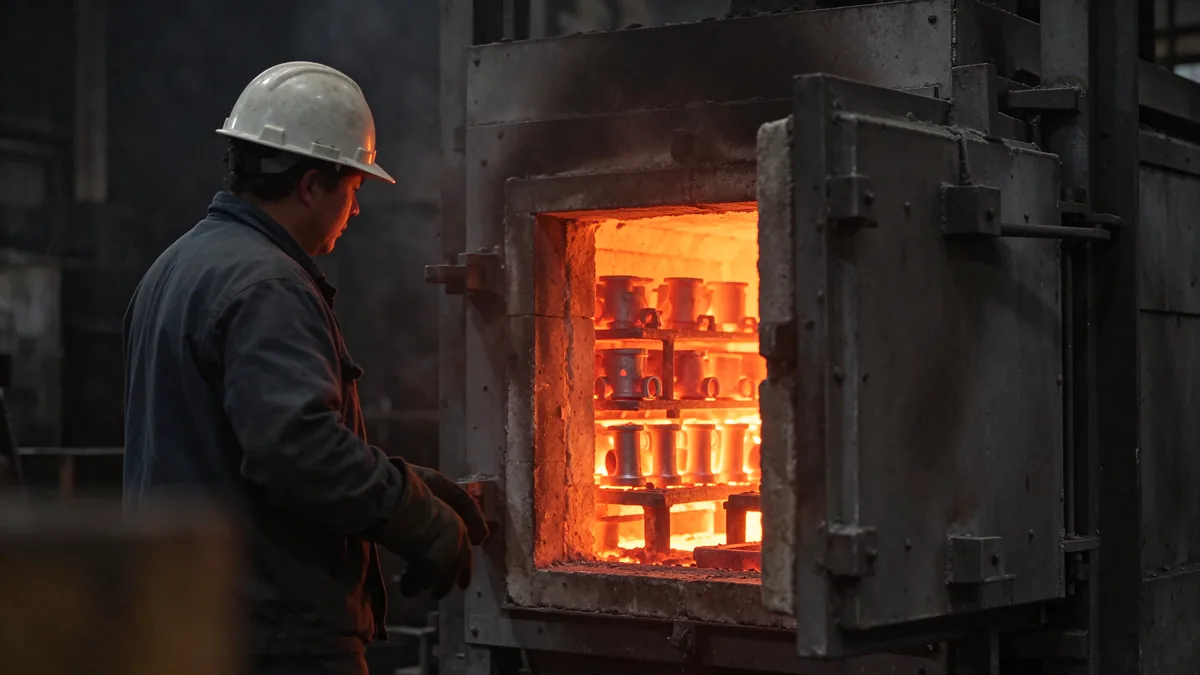
Solution Annealing: Temperatures, Soak and Quench
For austenitic stainless castings the operating window is roughly 1040–1120 °C. Below that, chromium carbides formed during cooling do not fully dissolve; above it, grain growth and heavy scaling start to cost you surface quality and straightness. With thinner sections and lighter loads the practical window narrows further, and that is a decision for the foundry's process sheet rather than something to be improvised at the furnace.
The hold time is set by section thickness rather than by a fixed clock — commonly around one hour per 25 mm of section at temperature, with a minimum that covers the whole load. The part of the cycle that is most often under-controlled is the cool. The casting has to pass through the 450–850 °C band quickly, because that is where chromium carbide precipitation happens in austenitic grades. A casting left to cool slowly inside a hot furnace effectively sensitises itself, and no certificate will show it.
Water quenching a thin, complex casting is a distortion risk, and forced-air cooling is a legitimate compromise when the section is light and the quench is monitored. What is not legitimate is calling an uncontrolled furnace cool a solution anneal.
Stress Relief: The Step That Gets Skipped
Residual stress is the reason a casting that measured correctly at the foundry moves after the first rough machining pass. Relief is cheap relative to scrapping a half-machined part, but it has to be sequenced correctly: after rough machining and after any weld repair, before finish machining.
Austenitic stainless is the awkward case. Stress relief in the 450–850 °C band sits exactly where sensitisation happens, so a well-intentioned low-temperature relief can trade dimensional stability for corrosion resistance. The usual answers are either a full solution anneal with rapid cooling, which fixes both, or a low-temperature relief accepted only where the part will not see a corrosive environment. Both are defensible; guessing is not.
Carbon and low-alloy castings are simpler. A relief hold below the tempering temperature, with controlled heating and cooling rates, removes most of the locked-in stress without touching the properties the grade was bought for.
Duplex and Super Duplex: A Different Rule
Duplex grades are not "stainless with more chromium". Their corrosion resistance depends on having roughly equal amounts of ferrite and austenite, and that balance is set by the anneal and the quench rather than by chemistry alone. The correct condition is a solution anneal in the duplex window followed by a fast water quench. Slow cooling lets sigma phase and other intermetallic phases form, and the part loses toughness and chloride resistance while still passing a chemistry check.
Two temperature ranges to keep out of: long holds around 600–900 °C, where sigma phase grows, and long exposure around 320–500 °C, where the ferrite phase embrittles. If a duplex part needs stress relief for dimensional reasons, the cycle has to be chosen with the phase balance in mind rather than copied from the austenitic recipe. The material side of this is covered in the 2205 duplex casting guide.
Distortion, Scale and the Hidden Costs
Heat treatment changes size. A casting that is straight out of the shell will not necessarily be straight after a high-temperature quench, and the movement depends on asymmetry, section differences, fixturing and how the part was loaded. Three practical consequences:
- Allowance. If the part is heat treated between rough and finish machining, the machining allowance has to cover the movement, not just the cast tolerance. Deciding this after the first article is expensive.
- Straightening. Some parts are pressed or fixtured straight after quenching. That is normal, and it belongs in the process plan rather than being discovered at inspection.
- Surface. High-temperature treatment leaves oxide and a lightly decarburised skin. On stainless this is normally removed by blasting, pickling or machining; leaving it on a sealing face creates a corrosion site that looks like a material fault.
Fixturing during the quench is the cheapest control available. Batch loading a slender part flat on a tray and water quenching it produces a different result from hanging it vertically — and neither result is wrong until someone writes down what the drawing needs.
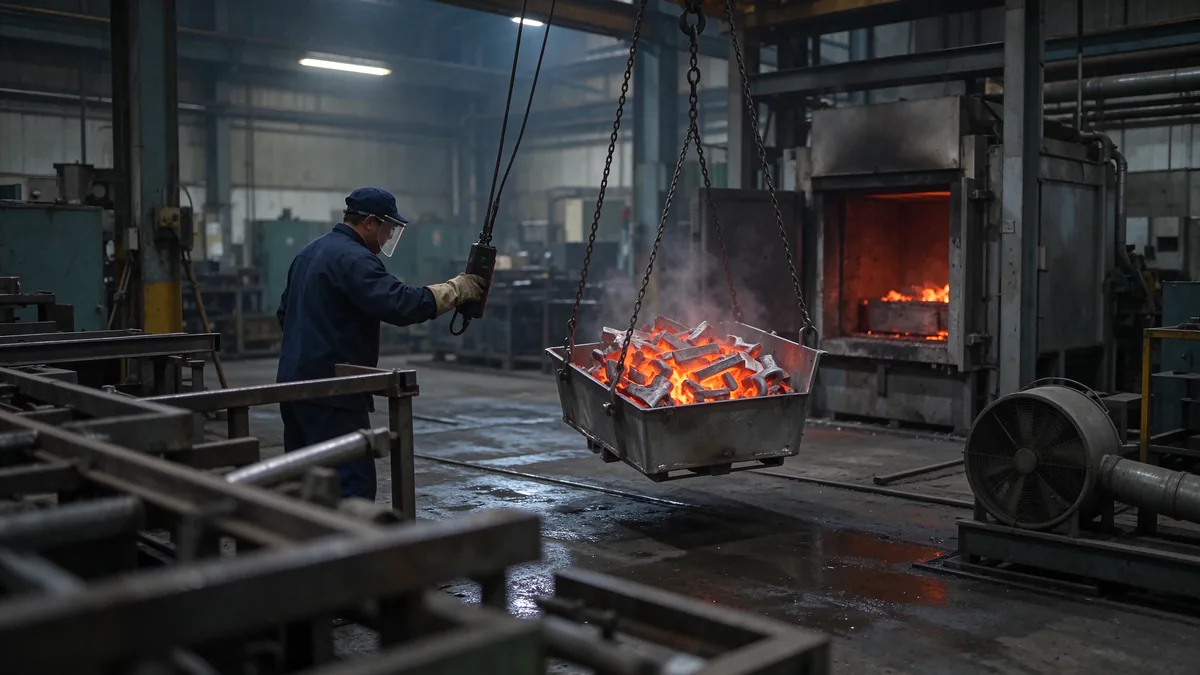
Proving It Was Done: Test Bars, Hardness and Certificates
Heat treatment is invisible in the finished part, so the evidence has to be built deliberately. Four items do most of the work:
- A test bar per heat. Separately cast coupons, treated with the production load, are the only reliable way to show that the cycle reached the metal rather than the furnace air.
- Hardness on the part or the coupon. A quick screen for whether the condition is plausible. It confirms consistency, not corrosion resistance.
- Mechanical properties from the coupon. Tensile and, where specified, impact results tied to the same heat number as the castings.
- A cycle record. Furnace, load, set point, actual chart, soak time and cooling method, signed and traceable to the heat numbers in the shipment.
Metallography is the check that catches a sensitised austenitic grade or sigma phase in duplex: a polished and etched section shows grain-boundary carbides or intermetallic phases that hardness testing will happily miss. Where corrosion resistance is the reason the alloy was chosen, asking for that check on the first article is cheaper than discovering the problem in service.
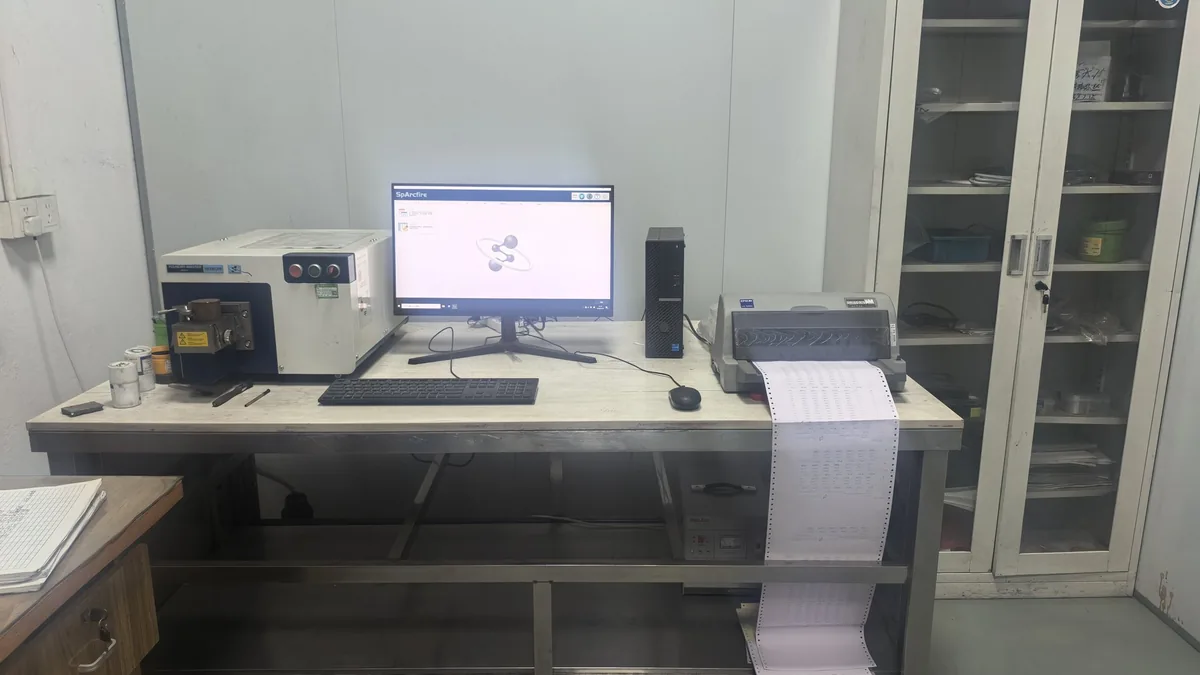
What to Write on the Drawing and the Purchase Order
Most heat treatment disputes are specification disputes. Five items on the drawing prevent nearly all of them:
| Item to specify | Why it matters | Weak wording to avoid |
|---|---|---|
| Condition, by name | Solution annealed, stress relieved and aged are different cycles with different results | "Heat treated" |
| Governing standard | Anchors acceptance to a published requirement instead of a conversation | "Per good practice" |
| Process sequence | Whether treatment happens before or after rough machining changes both allowance and result | Nothing stated |
| Evidence required | Cycle record, test bar results, hardness and metallography agreed up front, not negotiated at shipment | "Certificate of conformity" alone |
| Post-treatment surface | Oxide removal, pickling or blasting on functional surfaces | Left to the shop |
The related inspection requirements — chemistry, mechanical properties, dimensional checks and NDT — are laid out in casting inspection and NDT, and the tolerance side, including what movement heat treatment adds, is in investment casting tolerances.
Frequently Asked Questions
Is heat treatment always required for stainless castings?
For the austenitic casting grades it is normally written into the material standard, so treating it as mandatory is the safe default. Copper alloys and some carbon steel grades are supplied as-cast or stress relieved unless a specific property is requested. The honest answer depends on the grade and the service, which is exactly why the condition belongs on the drawing.
Can heat treatment fix a casting that is already out of tolerance?
No. Treatment can move a part and straightening can recover a small deviation, but it is not a correction process. A casting outside the as-cast tolerance is a tooling or process question, and heat treatment usually makes the deviation less predictable rather than smaller.
Why does a CF8M part pass chemistry but corrode early?
Chemistry is checked on the melt, not on the grain boundaries. If the part cooled slowly through the carbide precipitation range, chromium is consumed in boundary carbides and the surrounding matrix is left poorer in the element that makes the alloy stainless. The part is chemically correct and metallurgically wrong, which is why the cycle record and metallography matter as much as the heat analysis.
Does solution annealing soften the part too much?
It restores the annealed condition the grade was designed around, which is normally what the specification asks for. If a harder condition is needed, that is a different alloy or a different treatment such as ageing, decided at the design stage rather than by shortening the anneal.
How does weld repair interact with heat treatment?
Repair welding adds a new stress field and a new heat-affected zone on top of the casting's own. On stainless and duplex grades the repair is normally followed by the appropriate post-weld treatment, and the repair map — where, how much, by which procedure — travels with the part. A repair that leaves the drawing's heat treatment requirement unmet is a non-conformance, not a cosmetic detail.
What is the cheapest way to get this right on a new part?
Specify the condition and the standard on the drawing, agree the process sequence with the foundry before tooling is cut, and require the first article to include the cycle record plus one metallographic check. That is a small cost once, against the cost of reworking a batch whose only fault is invisible.
Conclusion
Heat treatment is where the metallurgy of a casting is finished. Solution annealing decides whether an austenitic grade is actually stainless in service; stress relief decides whether it stays straight through machining; the duplex cycle decides whether the phase balance survives. None of it shows on a surface inspection, and all of it shows eventually in a claim. Specify the condition by name, anchor it to the material standard, sequence it correctly against machining, and ask for evidence that ties the cycle to the heat number. That is the whole discipline, and it is cheaper than the alternative.
Related reading: investment casting defects, casting material selection, and 304 vs 316 vs 316L casting grades.
Ready to Discuss Your Casting Project?
Send us your drawings or requirements for a quotation. Material, heat treatment condition, machining note and quantity help our team prepare a practical response. OEM/ODM welcome.
Get a Free Quote View Our Products