
Three-Way Valve Body Casting (CF8 / CF8M / CF3M)
Cast three-way valve bodies with three flanged ports, mixing and diverting flow paths and a machined seat, in CF8, CF8M and CF3M stainless steel.
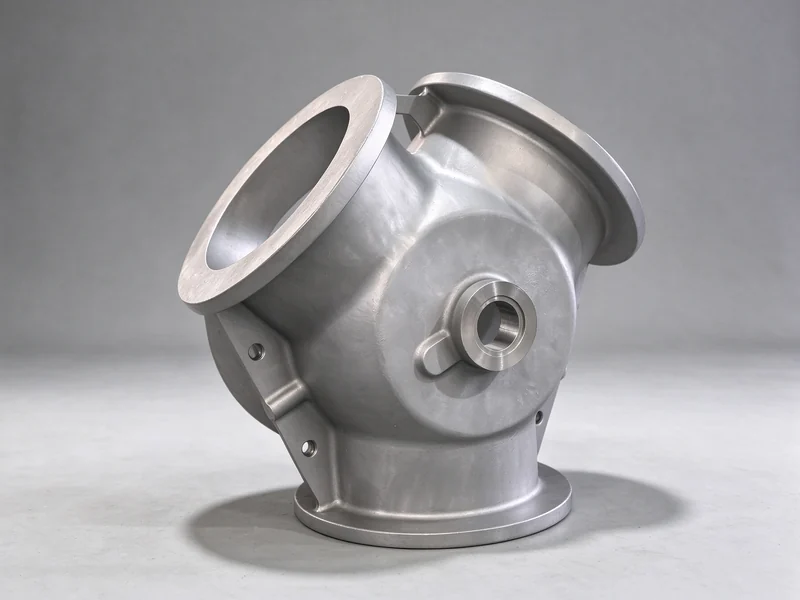
Three-Way Valve Body
Investment cast three-way valve bodies in CF8, CF8M and CF3M. Three flanged ports with machined faces and seat, for mixing, diverting and bypass duty in chemical, water and marine systems.
Product Specifications
| Material Grades | CF8 (304 equivalent), CF8M (316 equivalent), CF3M (316L equivalent) |
|---|---|
| Product Category | Valve Bodies |
| Casting Process | Investment Casting (Lost-Wax) |
| Machining Support | Machining support: Drilling, Tapping, Milling, Turning; operations arranged to approved drawings |
| Surface Finish | As-cast, sandblasted or polished finish as required; other finishing options discussed by drawing |
| Tolerance | ±0.2mm casting allowance; machining tolerance confirmed per drawing |
| Certification | ISO 9001; material records can be arranged by agreement |
| Order Quantity | Reviewed after drawing and quantity confirmation |
| Lead Time | Confirmed after drawing review and scheduling; sample timing evaluated separately |
| Customization | All castings custom made based on customer drawings |
Need a Custom Three-Way Valve Body?
Send us your drawings or specifications for a free quotation after drawing or requirement review.
Get a Free Quote WhatsApp UsProduct Overview
A three-way valve body splits or combines flow between three ports: two side ports and a bottom or centre port, arranged as T-port, L-port or a fixed mixing chamber. The body carries the seat, the stem bore and the bolted port flanges, so flange faces, gasket lands and the seat area are machined while the flow passages stay as-cast. Bodies are produced by Wuxi Huayong Metal Technology Co., Ltd. by investment casting in CF8, CF8M or CF3M stainless steel, with port faces, seat and stem bore finished to the customer drawing.
All valve bodies are custom manufactured from customer drawings or samples: port centre distances, flange sizes, bore diameter, seat geometry and stem bore come from the drawing rather than a catalogue. Designs are reviewed for castability, passage access and core stability before tooling. Quality review may include chemistry records, dimensional checks, pressure testing and selected test methods arranged by drawing, code or order requirement.
Material Options
The standard grades for this part are the cast austenitic stainless family: CF8 (304 equivalent), CF8M (316 equivalent) and CF3M (316L equivalent). CF8 covers general water and mildly corrosive duty; CF8M adds molybdenum for chlorides and chemical media; CF3M is the low-carbon variant chosen where welded or heavy-section parts need to avoid sensitisation. All heats are verified with spectrometer analysis, and other grades can be reviewed against the medium and pressure rating.
| Material Family | Common Grades | Key Properties | Typical Applications |
|---|---|---|---|
| Stainless Steel | CF8M, CF8, CF3M, CF3, 316L, 304L | Good corrosion resistance, good mechanical properties | Chemical, food, marine, water treatment |
| Carbon Steel | WCB, WCC, LCC, LC2 | Good strength, weldability, cost-effective | Oil & gas, power, general industrial |
| Alloy Steel | WC6, WC9, C5, C12A, 42CrMo | High temperature strength, wear resistance | Power generation, high-temp service, automotive |
| Duplex Steel | CD4MCu, CD3MN, 2205 | High strength, good pitting resistance | Oil & gas, desalination, chemical |
| Copper Alloy | C95400, C93200, C83600, Tin Bronze | Good wear resistance, corrosion resistance | Bearings, gears, marine, decorative |
| Heat Resistant | HK30, HU31, 310S, 309S | High temperature oxidation resistance | Furnace parts, heat treatment, power |
Manufacturing Process
1. Pattern Making
We produce high-precision wax patterns using injection molding. The wax patterns are exact replicas of the final valve body, including the three port passages, seat boss and stem bore.
2. Shell Building
The pattern tree is repeatedly dipped into ceramic slurry and coated with refractory sand. This process is repeated 6-8 times to build a strong, heat-resistant ceramic shell.
3. Dewaxing & Preheating
The ceramic shell is placed in an autoclave where steam melts the wax, which drains out. The empty shell is then preheated to 1000-1100°C to remove residual moisture.
4. Melting & Pouring
Metal is melted in induction furnaces under carefully controlled conditions. The molten metal is poured into the preheated ceramic shells.
5. Shell Removal & Cutting
After solidification and cooling, the ceramic shell is removed by mechanical vibration and blasting. The individual components are then cut from the sprue.
6. Heat Treatment
All castings undergo proper heat treatment to achieve optimal mechanical properties and material structure.
7. Machining Support
Machining support can be arranged according to approved drawings. Critical dimensions are checked against approved drawings.
8. Surface Treatment & Testing
Finished components may include surface finishing and arranged inspection such as dimensional review and chemistry records.
Quality Control & Testing
Quality review follows the agreed order process; final condition is checked against approved drawings and specifications:
- Chemical Analysis: Spectrometer analysis of every heat; material test records can be arranged by order requirement or agreement.
- Mechanical Testing: Mechanical or hardness checks can be arranged when specified on the order
- Dimensional Inspection: Critical dimensions checked against approved drawings
- Inspection Support: Selected penetrant, radiographic or ultrasonic methods can be arranged according to drawing, code or customer requirement
- Microstructure Examination: Metallographic review can be arranged when specified on the order
- Pressure Testing: Hydrostatic or pneumatic pressure tests can be arranged for pressure-containing components when specified
Applications
Three-way valve bodies are used wherever flow has to be mixed, split or diverted without two separate valves:
- Chemical Processing: Mixing, diverting and bypass duty on acid, caustic and solvent lines
- Water Treatment: Filtration backwash, dosing and distribution manifolds
- Marine & Offshore: Ballast, cooling and fire-main changeover valves
- Food & Beverage: CIP routing, product recovery and sanitary divert lines
- Pharmaceutical: Clean utility and process routing where 316L-type chemistry is specified
- Power Generation: Cooling water, condensate and auxiliary system changeover
- Oil & Gas: Utility water, chemical injection and test manifolds
- Pulp & Paper: Stock, liquor and bleach-plant flow switching
- HVAC & Building Services: Chilled water and heating changeover in plant rooms
- Mining & Slurry: Cyclone feed and tailings line diversion with wear allowance
Why Choose Huayong for Your Three-Way Valve Bodies?
- Process Coverage: Investment casting support with machining, inspection and finishing coordination
- Material Expertise: Experienced in CF8, CF8M and CF3M cast stainless, plus duplex, carbon, alloy and copper alloys
- ISO 9001 Quality System: Documentation and inspection records managed according to order requirements
- Custom Manufacturing: All parts made to your exact drawings and specifications
- Competitive Pricing: Factory-direct pricing with no middleman markup
- Fast Response: Quotation and technical support are arranged after requirement review.
- Application Support: Components reviewed for industrial, fluid, machinery and process-equipment applications.
- Order Review: Prototype and production quantities reviewed after drawing review
Ready to Start Your Project?
Send us your 2D/3D drawings, samples, or part requirements for a free custom quotation after drawing or requirement review.
Request a Quote View All ProductsEngineering Design Tips for Three-Way Valve Bodies
1. Port Flange Faces and Bolt Circles
Each port face is a sealing surface, so specify flatness and bolt-hole position per face rather than for the body as a whole. A common call-out is flatness within 0.05 mm and bolt-hole position within ±0.2 mm, checked after machining.
2. Seat and Stem Bore Alignment
The seat, stem bore and actuator mounting face share a datum in most valve designs. State the run-out or concentricity limit so it can be verified after machining; misalignment shows up as leakage or torque rise at the ends of travel.
3. Wall Section at the Branch Junction
The junction where the third port meets the main passage is the heaviest section of the body and the last to solidify. Keep the transition gradual, put fillets of R3 or more at internal corners, and avoid placing a thick boss directly against a thin port wall.
4. Machining Allowance on Faces and Seat
Allow 2-3 mm on port faces, the seat land and the stem bore so the as-cast skin is removed. Gasket lands and seat surfaces should never be left as-cast, and tapped actuator holes need enough boss height for full thread engagement.
5. Pressure Rating and Testing
Pressure capability follows wall section, flange class and the agreed NDT level. Hydrostatic or pneumatic shell testing and seat-leak testing can be arranged when the drawing, code or customer specification requires them.
Frequently Asked Questions
Q: Which of CF8, CF8M and CF3M should I specify?
A: CF8 (304 equivalent) suits general water and mildly corrosive service. CF8M (316 equivalent) adds molybdenum for chlorides, chemical media and marine duty. CF3M is the low-carbon 316L equivalent, chosen where welded or heavy-section parts must avoid sensitisation.
Q: Can the port layout be customised?
A: Yes. Port centre distances, flange sizes, T-port or L-port passage layout, seat geometry and stem bore are all made to the customer drawing.
Q: Is the body cast or machined from bar?
A: The standard route is investment casting to a near-net shape with as-cast flow passages, then machining of port faces, seat and stem bore. Bodies machined from bar or from a fabricated assembly can be discussed for one-off sizes.
Q: Can you pressure test the body?
A: Hydrostatic or pneumatic shell testing and seat-leak testing can be arranged when specified on the drawing or order; the test pressure is agreed with the customer.
Q: Which inspection records can be supplied?
A: Chemistry, dimensional, pressure-test and selected NDT records can be prepared according to order requirements under the ISO 9001 quality system.
Related Products
Request a Quote for Three-Way Valve Body Casting
Send us your requirements — we review the inquiry and prepare a quotation after drawing or requirement review.