
The 30-Second Summary
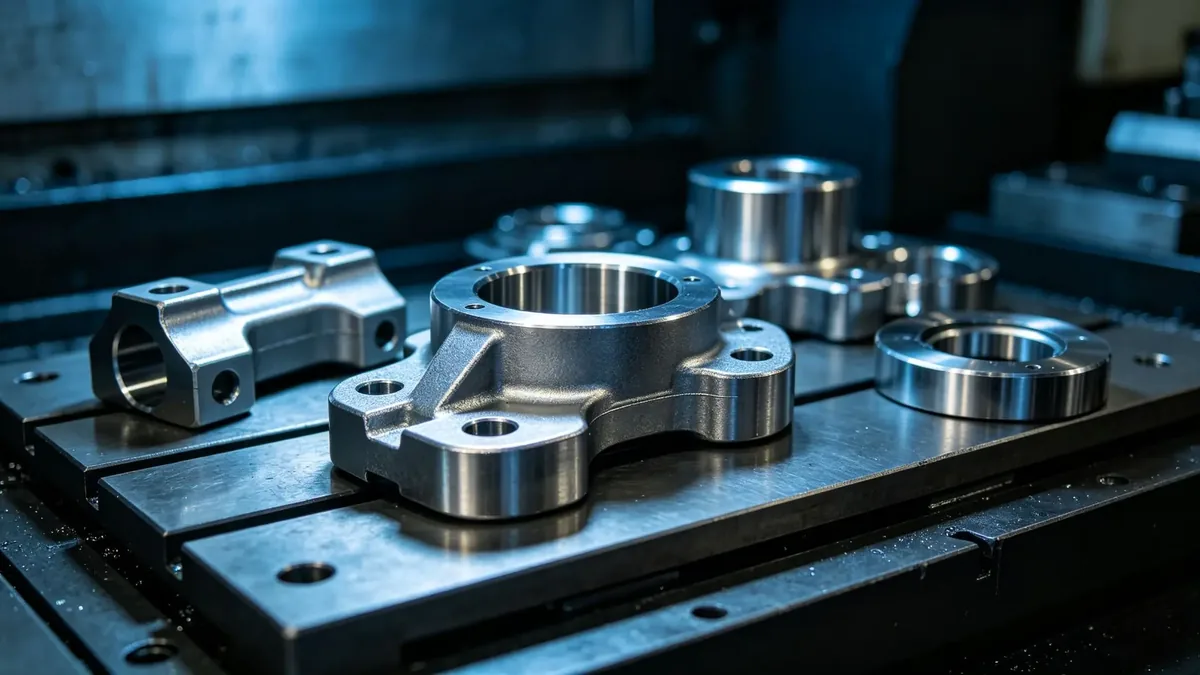
The decision is rarely "casting or machining" in the abstract. It is a question of how much material the process must remove and whether the geometry can be reached by a cutter. A part with complex internal passages, curved flow surfaces, or a shape that would require removing 60 percent of a billet is usually cheaper as a casting with a finish machining operation. A part that is essentially a prismatic block with a few holes, made in low volume from an easily machined alloy, is almost always cheaper machined from stock. Most real components sit in between, and the economically correct answer is a near-net casting plus machining of the critical features only.
Two Different Starting Points
Investment casting starts from a wax pattern and a ceramic shell, and produces a shape close to final form in one operation. Material is placed where the design needs it. The tooling cost is front-loaded onto a wax die, and the per-part cost falls steeply with volume.
CNC machining starts from bar, plate or a forged billet and removes material until the shape appears. There is no dedicated tooling beyond programming and fixtures, so the first part can be made quickly, but every part carries the full cost of the material removed and the machine time consumed.
Those two starting points explain nearly every trade-off that follows. Casting buys geometry at the price of tooling and a process setup; machining buys flexibility at the price of material waste and cycle time.
Head-to-Head Comparison
| Criterion | Investment casting | CNC machining from stock |
|---|---|---|
| Up-front tooling | Wax die and shell process setup; a real investment before the first part | Programming and fixtures only; low or zero dedicated tooling |
| Time to first part | Longer, because tooling must be built, tried and inspected | Short; a prototype can be cut from stock in days |
| Cost behaviour with volume | Falls sharply; tooling is amortised and per-part labour is low | Broadly linear; each part carries material and machine time |
| Material yield | High for complex shapes; the metal is where the design needs it | Low for complex shapes; removed material becomes chips |
| Geometry freedom | Internal passages, curved flow paths, undercuts, thin walls | Limited by tool access, cutter length and fixturing |
| Tolerance and finish as delivered | Casting tolerance class plus a defined machining allowance | Tight tolerance and fine finish directly, at a cost in time |
| Material range | Wide: stainless, duplex, nickel and cobalt alloys, copper alloys, carbon steel | Wide, but hard alloys raise tool wear and cycle time sharply |
| Design change mid-project | Expensive once the die exists; cheap before it does | Cheap; usually a program change |
| Quality risks | Porosity, inclusions, dimensional variation from the process | Residual stress, chatter, tool marks, material waste cost |
When Casting Is the Better Route
Casting wins whenever the shape is expensive to cut. Five situations cover most cases:
- Complex internal or curved geometry. Pump impellers, volutes, valve bodies and manifold blocks have flow paths that no standard cutter can reach economically — or at all.
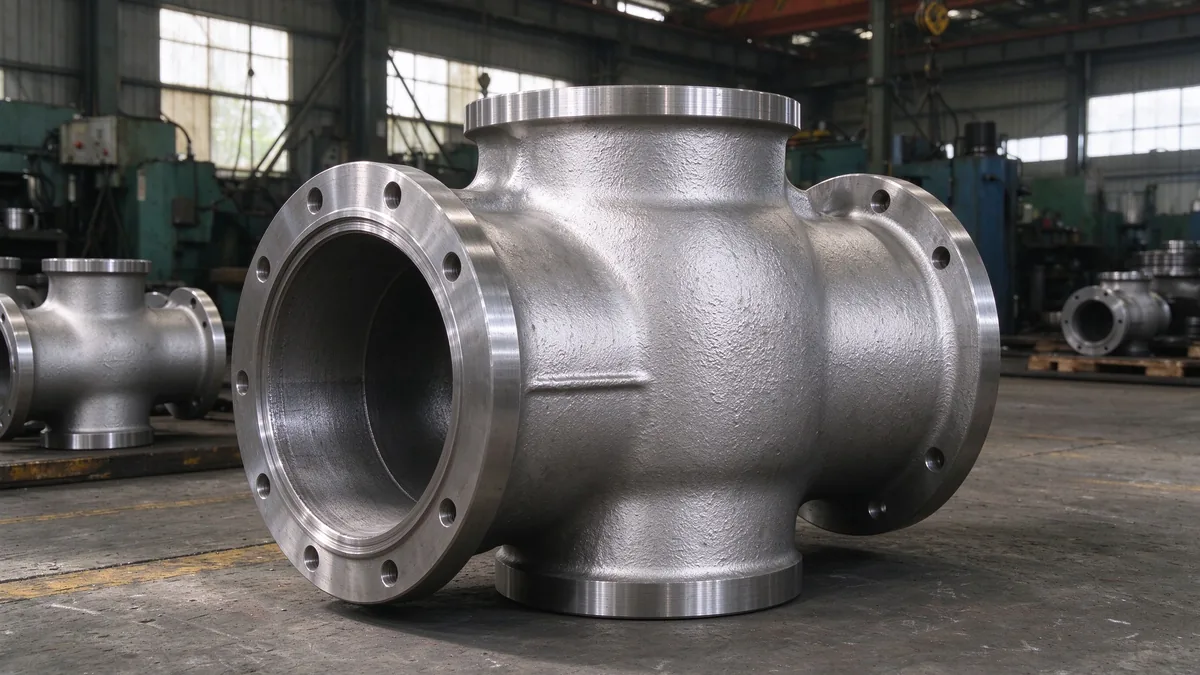
- High material removal ratio. If machining from stock would turn most of the billet into chips, especially in an expensive alloy, casting pays for itself quickly.
- Thin walls with stiffening features. Cast ribs and bosses add stiffness without adding machining operations.
- Repeat volume. Once the tooling is amortised, a casting is a low-labour part; machining remains a machine-hour part.
- Difficult alloys. Cutting 2205 duplex, CF8M or a nickel alloy is slow and wears tools; casting the shape and machining only the functional surfaces avoids most of that.
When Machining Is the Better Route
- Low volume or one-off. A single fixture or prototype does not justify a wax die and a shell process setup.
- Prismatic geometry. Blocks, plates, brackets and covers with simple pockets and holes are fast to cut and wasteful to cast.
- Very tight tolerances everywhere. If nearly every dimension needs precision, casting offers little advantage because most surfaces will be machined anyway.
- Rapid iteration. Design is still moving and tooling would be scrapped with each revision.
- Small parts from easily machined stock. Where blank cost is low and cycle time is short, the casting route has nothing to beat.
The Hybrid Route Most Components Actually Use
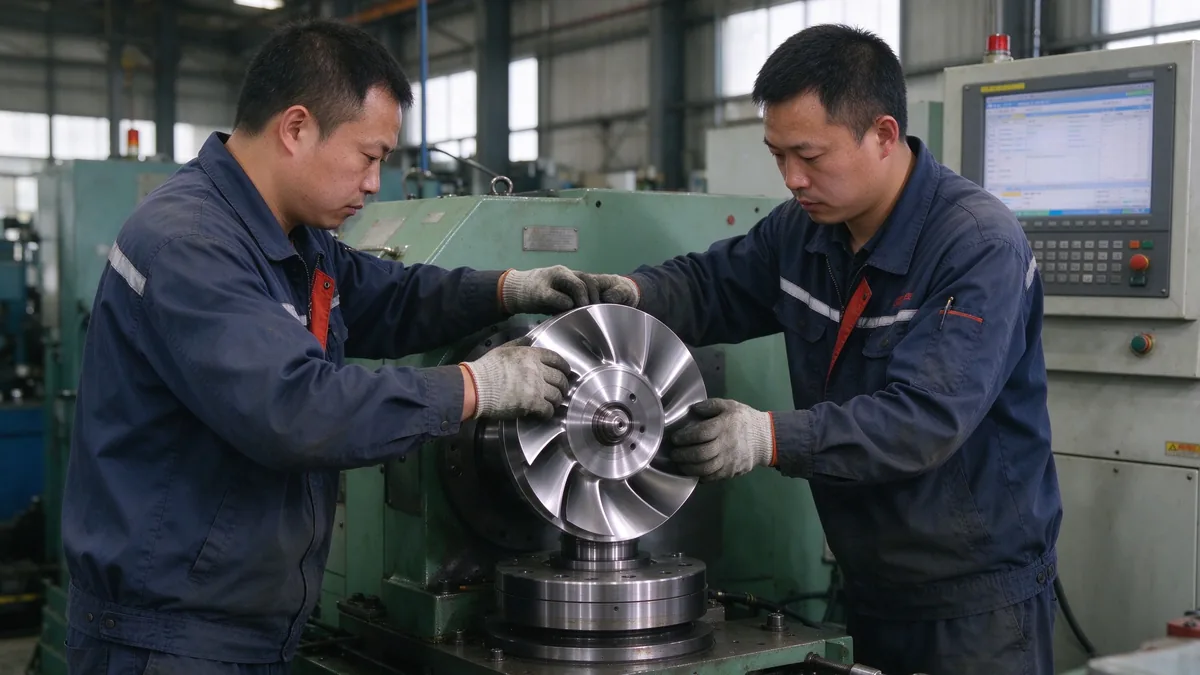
In practice, few industrial parts are purely cast or purely machined. The common structure is a near-net casting with machining confined to the features that need precision: flange faces, bores, sealing surfaces, threaded connections and datum features. This splits the work along its natural line — the foundry produces the shape, the machine shop produces the precision.
That division has three practical consequences. First, the machining allowance must be planned deliberately, surface by surface, or the shop will either leave skin or cut into tolerance. Second, the datum strategy has to be agreed between foundry and machine shop, because a casting with no machined datum cannot be located repeatably. Third, inspection must specify the stage: a defect that will be removed by machining is not the same as a defect left on the finished face.
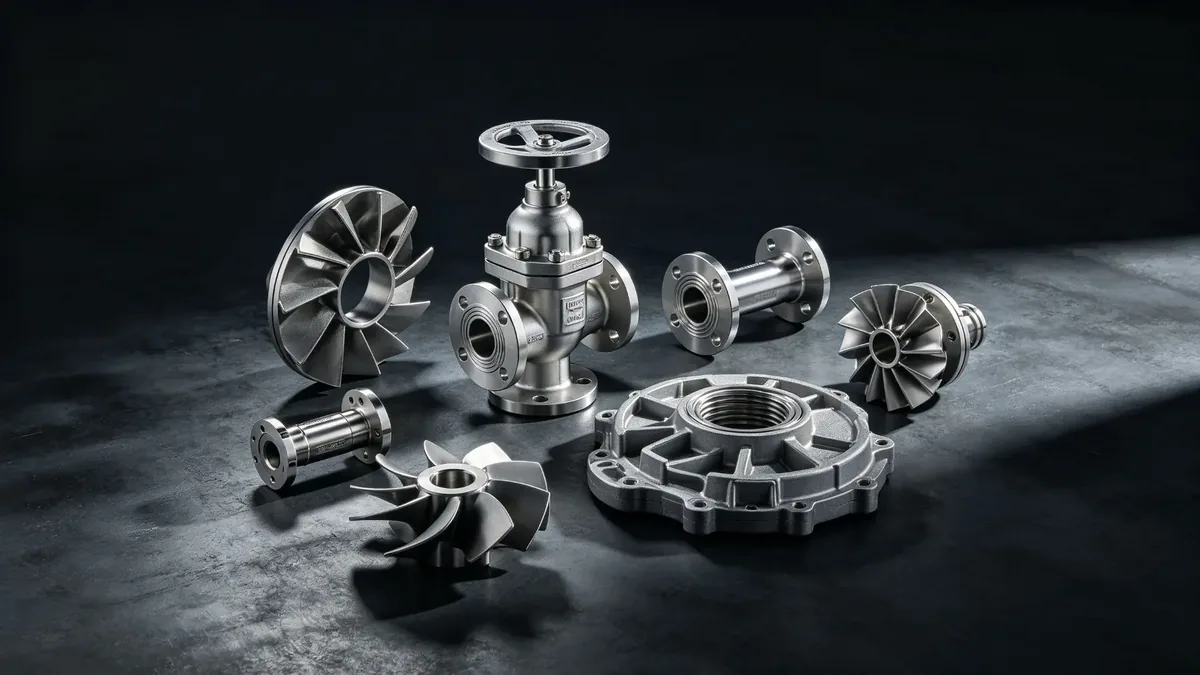
Valve bodies are the classic example. The flow path and the body shape come from casting; the flange faces, the seat area and the stem bore are machined. Pump casings follow the same logic, as does almost every impeller with a machined hub and balanced shroud. Component-specific process choices are discussed in valve casting process selection and pump casting parts.
The Break-Even Logic, in Plain Numbers
The comparison is not a feeling; it is an equation. For each route, cost per part equals:
(tooling ÷ quantity) + material input cost + processing time × shop rate + finishing and inspection + expected scrap cost.
Three terms decide the answer most of the time. The tooling term shrinks as quantity rises. The material input term is governed by buy-to-fly ratio: a casting that weighs 1.3 kg to make a 1.0 kg part wastes far less than a billet that weighs 3.5 kg for the same result. The processing term is dominated by how many surfaces need machining and how hard the alloy is to cut.
Illustrative only: consider a 316L part of moderate complexity, 1.0 kg finished. Machining from a 3.2 kg billet might involve 90 minutes of cutting; casting 1.4 kg near-net and machining the functional faces might involve 25 minutes. At the same shop rate, the casting route saves roughly an hour of machine time and about 1.8 kg of stainless input per part — a saving that amortises a wax die over a few hundred pieces, and compounds after that. Substitute your own weights, rates and quantities; the structure of the comparison stays the same.
What Each Route Does to Quality
Casting introduces process-dependent quality risks that machining does not: porosity, shrinkage, inclusions and dimensional variation from the pattern and the shell. Those risks are managed by design rules, gating and an inspection plan rather than by machine accuracy. The mechanisms are covered in investment casting defects.
Machining introduces its own set: residual stress released when material is removed, distortion in thin sections, chatter on long overhangs, and tool marks that can become initiation points on a fatigue-critical surface. Neither route is inherently "safer"; each has a characteristic failure mode that the specification has to address.
| Cost driver | Casting route | Machining route |
|---|---|---|
| Material input | Low to moderate; near-net weight plus gating | High; billet weight versus finished weight |
| Tooling | Wax die, shell setup, first article | Programming, fixtures, cutters |
| Labour and machine time | Low per part at volume; process labour is shared | High and proportional to removed volume |
| Finishing | Machining of functional faces only | Often all faces, plus deburring |
| Scrap risk | Concentrated in process setup and first article | Spread across every part through tool wear and setup |
Decision Checklist
- What percentage of the starting stock would be removed to machine this part?
- Does the geometry contain internal passages, curved surfaces or undercuts that cutters cannot reach?
- How many surfaces genuinely need precision, and how many can stay as-cast?
- Is the alloy easy or difficult to cut?
- What is the annual quantity and the expected programme life?
- Is the design still moving, or is it frozen for production?
- Which quality risk is more acceptable in service: porosity in a casting, or residual stress and tool marks in a machined part?
- Can a single supplier manage both routes so the datum strategy is consistent?
Frequently Asked Questions
Is a casting always cheaper at high volume?
Not always, but usually when the geometry is complex and the machining allowance is modest. If the part is simple enough that machining is fast, and the alloy is easy to cut, machining can stay competitive even at volume because it avoids tooling amortisation and process setup.
Can a casting replace a forging?
Sometimes, but they are not equivalent. Forgings offer a wrought, directional grain structure and better fatigue performance in the direction of the forging flow. Castings offer greater geometric freedom. For pressure-retaining and flow components, castings are the norm; for highly stressed shafts and discs, forgings usually remain the choice.
How much machining allowance should I leave?
Typically 1.5–2.5 mm on general faces, more on large or distortion-prone surfaces, and less on precision bores where a semi-finish operation will follow. The allowance should be stated per surface on the drawing rather than left to convention.
Does casting weaken the part?
A sound casting with appropriate section design performs as the alloy allows. The relevant concerns are local porosity, coarse grain in heavy sections and residual stress — all manageable through design rules, process control and heat treatment. A casting is not inherently weaker than a machined part; the failure modes are simply different.
What if the volume is too low for tooling but the geometry is too complex to machine?
That is the hardest case, and the usual answers are a prototype machined from stock with compromises on geometry, or a modest investment in tooling justified by the value of the part. It is worth pricing both routes for the real annual quantity rather than for the first order alone.
Conclusion
The casting-versus-machining question resolves into three numbers: how much material must be removed, how many surfaces need precision, and how many parts will be made. Complex geometry, expensive alloy and repeat volume point to casting with finish machining. Simple geometry, low volume and a moving design point to machining from stock. Most industrial components end up as a near-net casting with machined functional faces, and the quality of that decision shows up later as either a stable process or a permanent argument about allowances, datums and inspection stages.
Related reading: investment casting cost, lost wax casting vs die casting, and investment casting vs sand casting.
Ready to Discuss Your Casting Project?
Send us your drawings or requirements for a quotation. Material, geometry, machining note and quantity help our team prepare a practical response. OEM/ODM welcome.
Get a Free Quote View Our Products