
Investment Casting vs Sand Casting: Which Process is Right for You?
Choosing between investment casting and sand casting? This comprehensive guide compares precision, cost, lead time, and applications to help you decide.
When sourcing metal cast components, one of the first decisions you'll face is choosing the right casting process. Investment casting (also called lost-wax casting) and sand casting are the two most common methods, each with distinct advantages and ideal use cases.
Making the wrong choice can lead to higher costs, longer lead times, or parts that don't meet your specifications. In this guide, we'll break down everything you need to know to make an informed decision.
What is Investment Casting?
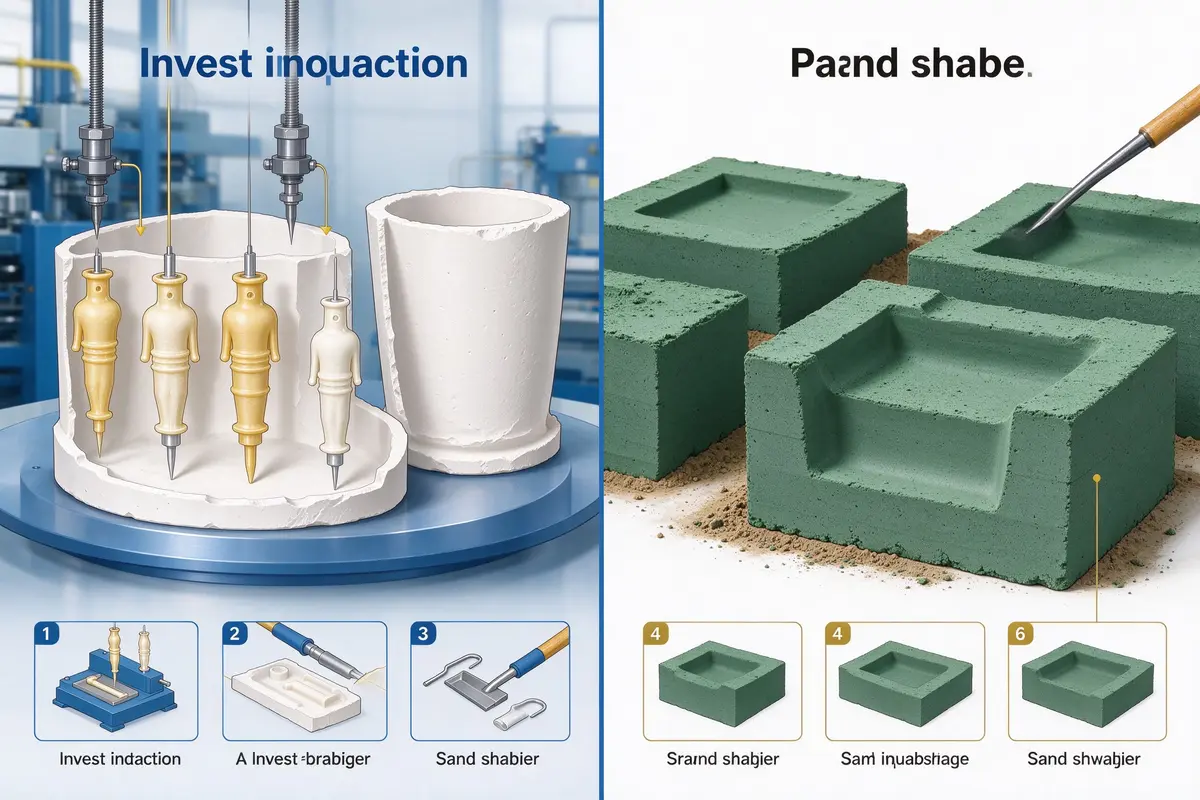
Investment casting, or lost-wax casting, is a precision manufacturing process that uses a wax pattern to create a ceramic mold. The process involves:
- Wax Pattern Creation: Injecting wax into a metal die to create an exact replica of the final part
- Assembly: Attaching multiple wax patterns to a sprue to form a "tree"
- Shell Building: Dipping the wax tree in ceramic slurry and sand to build a hard shell (typically 5-7 layers)
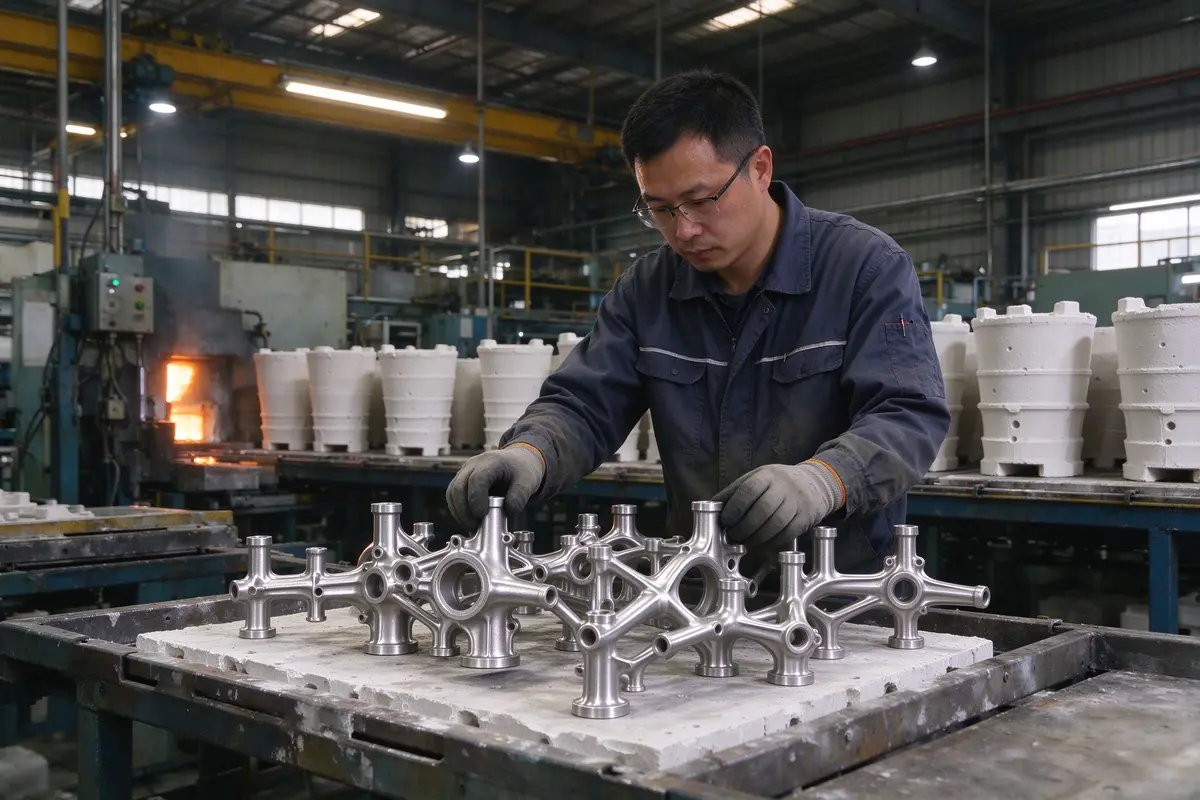
- Dewaxing: Melting out the wax in an autoclave, leaving a hollow ceramic mold
- Pouring: Pouring molten metal into the preheated ceramic shell
- Knockout & Finishing: Breaking away the ceramic shell, cutting off parts, and finishing
This process produces near-net-shape components with exceptional dimensional accuracy and surface finish, making it ideal for complex geometries that would be difficult or impossible with other methods.
What is Sand Casting?
Sand casting is the oldest and most widely used casting process. It uses a sand mold created by packing sand around a pattern. The process involves:
- Pattern Making: Creating a wood, metal, or plastic pattern of the final part (slightly oversized for shrinkage)
- Mold Making: Packing sand around the pattern in a flask, then removing the pattern to leave a cavity
- Core Setting: Placing sand cores to create internal passages (if needed)
- Pouring: Pouring molten metal into the sand mold
- Cooling & Shakeout: Allowing the metal to solidify, then breaking the sand mold to remove the casting
- Cleaning & Finishing: Removing gates, risers, and sand, then grinding and machining
Sand casting is known for its versatility and cost-effectiveness, especially for large parts and low-volume production runs.
Side-by-Side Comparison
| Factor | Investment Casting | Sand Casting |
|---|---|---|
| Dimensional Tolerance | ±0.05mm (±0.002") | ±0.5mm to ±1.5mm (±0.02" to ±0.06") |
| Surface Finish | Ra 1.6 - 3.2 μm (very smooth) | Ra 6.3 - 12.5 μm (rougher) |
| Part Complexity | Excellent - complex internal passages, thin walls | Moderate - simpler geometries preferred |
| Minimum Wall Thickness | 0.5mm - 1.5mm | 3mm - 6mm |
| Part Size Range | 5g to 50kg (typical) | 100g to several tons |
| Tooling Cost | High ($2,000 - $10,000+) | Low ($200 - $1,000) |
| Unit Cost | Higher per part | Lower per part |
| Lead Time | 4-8 weeks (tooling + production) | 2-4 weeks |
| Best Volume | Medium to high (100+ pcs/year) | Low to medium (prototypes to 1000s) |
| Materials | Virtually any castable alloy | Most alloys, especially ferrous |
| Machining Required | Minimal (near-net-shape) | Often significant |
Precision & Surface Finish: The Key Difference
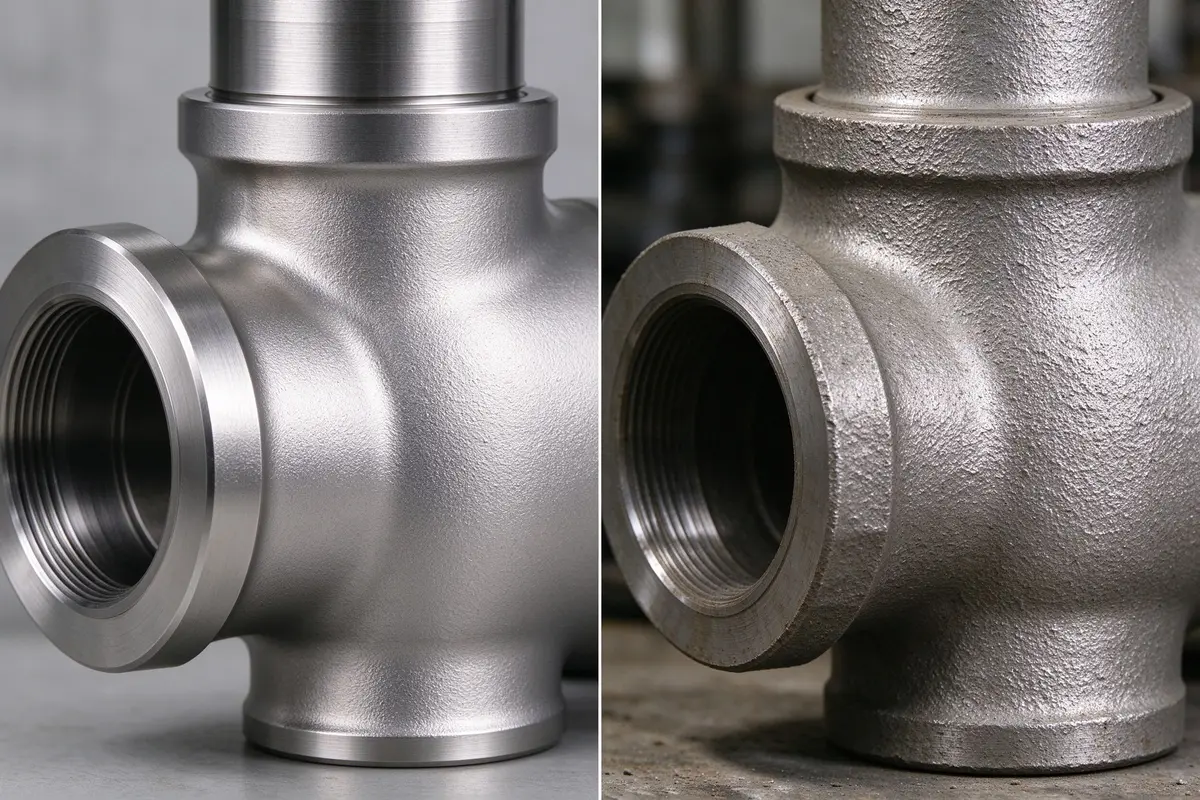
The most significant difference between the two processes is precision and surface quality. Investment casting produces parts that are significantly more accurate and smoother.
Investment Casting Advantages in Precision:
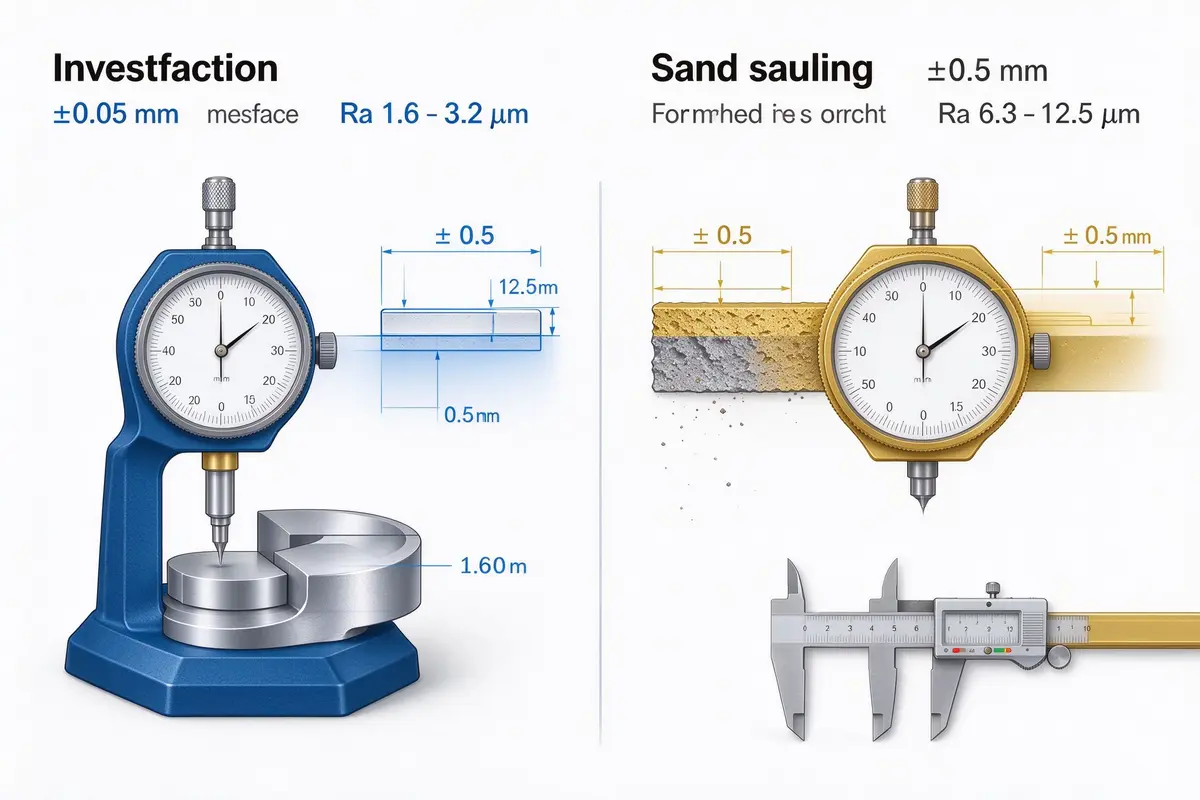
- Tighter tolerances: ±0.05mm vs ±0.5mm — that's 10x more accurate
- Better surface finish: Ra 1.6-3.2μm means parts often need little to no polishing
- Thinner walls: Can cast walls as thin as 0.5mm, impossible with sand casting
- Complex internal features: Ceramic cores allow intricate internal passages
- Less machining: Near-net-shape means lower secondary machining costs
Cost Analysis: When Does Each Process Make Sense?
Investment Casting Cost Structure:
- High upfront tooling: The wax injection die is expensive, but lasts for 100,000+ cycles
- Higher per-unit cost: The multi-step process is labor and energy intensive
- Lower machining cost: Near-net-shape parts require less CNC machining
- Break-even point: Typically 100-500 pieces per year, depending on part complexity
Sand Casting Cost Structure:
- Low tooling cost: Wood or plastic patterns are inexpensive
- Lower per-unit cost: Simple process, fast turnaround
- Higher machining cost: Rougher surfaces and looser tolerances require more machining
- Ideal for: Prototypes, large parts, and low-volume production
Not Sure Which Process You Need?
Our engineering team can review your drawings and recommend the most cost-effective casting process. Get a free consultation within 48 hours.
Get Free Consultation Browse ProductsHow to Choose: A Decision Framework
Choose Investment Casting When:
- ✅ You need tight tolerances (±0.1mm or better)
- ✅ Surface finish is important (Ra < 6.3μm)
- ✅ Your part has complex geometry or thin walls
- ✅ You want to minimize machining
- ✅ Annual volume is 100+ pieces
- ✅ Part weight is under 50kg
- ✅ You need repeatable quality for ongoing production
Choose Sand Casting When:
- ✅ You need large parts (over 50kg)
- ✅ Tolerances are loose (±0.5mm or more)
- ✅ You need fast prototypes or low-volume runs
- ✅ Budget is tight and tooling cost is a concern
- ✅ Surface finish is not critical
- ✅ You have machining capacity to finish the parts
Real-World Examples
Investment Casting Applications:
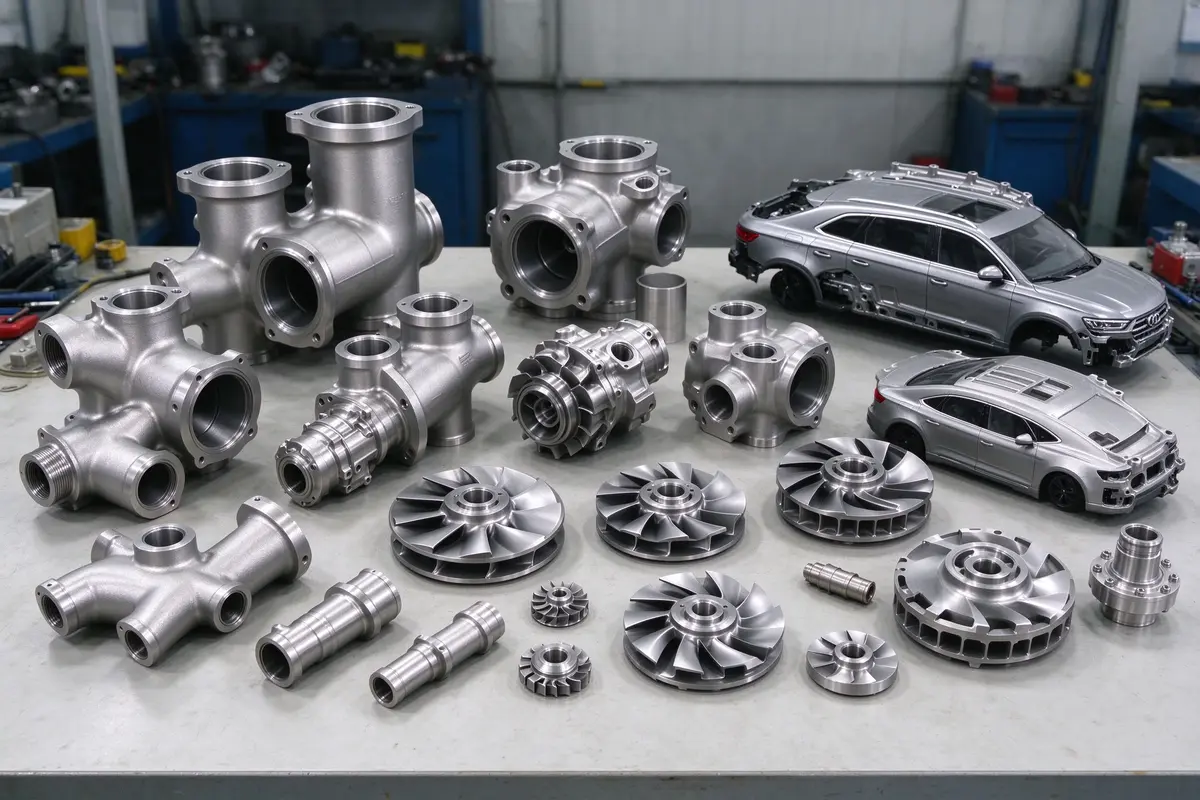
- Valve bodies — Need pressure-tight integrity and precise machining surfaces. See our ball valve body castings.
- Pump impellers — Complex blade geometry requires precision. See our pump impeller castings.
- Turbocharger housings — Thin walls and complex internal passages. See our turbo housing castings.
- Automotive components — Lightweight, high-strength parts with tight tolerances.
Sand Casting Applications:
- Large pump casings — Heavy, large-format parts
- Machine tool bases — Large, heavy cast iron structures
- Manhole covers — Simple geometry, high volume, low cost
- Structural brackets — Simple shapes, low volume
Can't Decide? Hybrid Approaches Exist
In some cases, a hybrid approach makes sense:
- Prototype in sand, production in investment: Use sand casting for quick, low-cost prototypes, then switch to investment casting for mass production
- Investment cast + CNC finish: Investment cast the near-net shape, then CNC machine critical surfaces for ultimate precision
- Sand cast + investment cast details: For very large parts with small complex features
At Huayong Metal, we offer both processes and can help you determine the best approach for your specific application.
Conclusion
There's no universally "better" process — it depends entirely on your specific requirements:
- Choose investment casting for precision, complex geometry, and medium-to-high volume production
- Choose sand casting for large parts, low volumes, and cost-sensitive projects
When in doubt, consult with an experienced foundry. A good casting partner will review your drawings, understand your requirements, and recommend the most cost-effective solution — even if it means suggesting a process they don't specialize in.
Ready to Get Started?
Send us your drawings for a free process recommendation and quotation. Response within 48 hours.
Request a Quote WhatsApp Us